
Christopher Brown Real Estate Developer Broker, Author: Why Agents Miss New Construction Opportunities
Most real estate agents are leaving the easiest deals on the table. That was the core message from my recent conversation with Christopher Brown, a 30-year veteran in real estate development, homebuilding, and new home sales. We sat down on the Why Do I Suck As a Real Estate Agent? Podcast to unpack why new construction is the overlooked "secret sauce" that could transform an agent's career.
Christopher Brown real estate developer broker author, and principal of NEXT New Homes Group in Sacramento, has seen it all from the builder side. He argues that with the right mindset and strategy, new construction deals are not just accessible but can become the most predictable, scalable part of your business.
Listen to the full episode:
My Conversation with Christopher Brown: The Most Overlooked Opportunity in Real Estate
Chris's journey started while he was still in college, selling a condo conversion on the beach in Santa Barbara. He worked his way up through a developer into construction operations, eventually moving back to his home base in Sacramento. Over 31 years, he has built three companies in the homebuilding space through his work at NEXT New Homes Group, giving him a unique builder-side perspective that most agents never get to see.
Our conversation revolved around a central theme: why do so many agents avoid new construction? Christopher Brown real estate developer broker author believes it is one of the biggest missed opportunities in the industry.
For agents willing to learn the process and drop their ego, it can be the key to building a sustainable, predictable business. It is not just about making a single sale. It is about forming partnerships that generate deals for years to come.
Why Most Agents Miss the New Construction Opportunity
The gap between agents and builders is often a self-inflicted wound. Chris pinpointed the primary reason: fear. Agents are insecure about their knowledge. They worry they will walk into a builder's sales office and look foolish because they do not understand the unique contracts or the specific process. According to professional standards and contract resources from the National Association of Realtors, new construction transactions require a different skill set than traditional resales.
But the fear runs deeper. It is tied to ego. Many agents, used to being the expert in a resale transaction, struggle to walk into a new home community where the on-site agent knows more about the product. They feel a loss of control. Instead of collaborating and becoming a champion for both their client and the builder, they avoid the situation altogether.
"New construction is the easiest deal you'll ever do—if you're willing to build the relationship and drop the ego."
Chris shared a powerful insight from one of his agents. A lot of agents are just fearful. They lack understanding of the new home deal, which operates very differently from a traditional resale. If you can overcome that fear and embrace being a team player, you unlock a goldmine.
The "Milk Run" Strategy: How I'd Build Builder Relationships Today
So how do you break through the fear and build those crucial relationships? Chris has a simple, effective strategy he calls the milk run real estate builders approach.
His advice is to treat builder relationships like a delivery route. You need to visit new home communities consistently—weekly or bi-weekly—to become a familiar, trusted face. The goal is not to show up with a buyer on the first visit. It is to build a genuine rapport with the on-site agents.
Identify new construction communities in your area or a niche you want to target
Visit consistently (weekly or bi-weekly) to build familiarity
Offer value first. Bring coffee, ask how you can help, and be a resource without asking for anything in return
Build rapport before asking for deals. This creates a foundation of trust that pays off later
For instance, a community like Chris's Valley Vista project in Sacramento is exactly the kind of place where showing up consistently pays off.
As Chris pointed out, on-site agents are stuck in their "box" five days a week. They do not have the flexibility of a resale agent. When you show up and offer value, you stand out. You get the inside track on canceled deals, upcoming phases, and even referrals for contingencies. It is a strategy that builds a long-term partnership, not just a transaction. For more insights on how to work with builders, Chris emphasizes that consistency is more important than intensity.

Visual Breakdown – The New Construction Opportunity Funnel
The new construction real estate strategy operates like a funnel. At the top, you invest time in building relationships with builders and on-site agents. That investment flows into the middle, where you gain access to buyer opportunities and insider deals before they hit the open market. At the bottom, those transactions generate referrals and long-term partnerships that feed back into the top of the funnel, creating a self-sustaining cycle of business.

From Fear to Confidence: How Agents Can Break Into New Construction
The best way to conquer new construction fears is to lean into the unknown. Chris emphasized the importance of being coachable. Instead of pretending to know everything, agents should approach builders with genuine curiosity.
"Go in and ask questions," Chris suggested. A simple statement like, "I do not understand this. I work in the resale world more than the new construction world. Tell me a little bit about this," can be incredibly disarming. You can find additional insights from Builder magazine on how builders view their partnerships with agents.
This vulnerability shifts the dynamic. It signals to the builder that you are interested in learning and are dedicated to serving your client's best interest. You move from being a competitor to being a collaborator. By asking smart questions and becoming a student of the builder's process, you build trust and position yourself as a partner, someone who understands the builder's development and consulting needs. Connect with Chris on LinkedIn to see how he approaches builder-agent collaboration.
Specialization is the Shortcut to Scaling Your Business
The "riches are in the niches" is more than a catchy phrase. It is a blueprint for longevity. Chris has seen firsthand how trying to be everything to everyone leads to burnout and inconsistency. Real estate niche specialization is the foundation of his business model.
His brokerage is structured to reflect this principle. He has three distinct agent types: those who only do resale, those who only do new home sales, and "hybrids" who are experienced enough to bounce into smaller subdivisions that do not require a full-time project.
His expertise isn't just in sales; it spans the full spectrum of homebuilding services, which gives him a unique perspective.
Choose your niche (new homes, luxury, first-time buyers, etc.)
Commit fully to understanding the systems and relationships within that niche
Build your business on the expertise you develop
The alternative is to chase every lead, every trend, and every opportunity, which leads to exhaustion without any real momentum. When you focus, you become a specialist. And specialists command authority, trust, and a predictable stream of business.
Visual Comparison – Generalist vs Specialist Agent
This comparison between new home sales vs resale agents highlights why specialization matters. A generalist tries to be everything to everyone. A specialist builds deep expertise in one area and becomes the go-to professional for that specific client type.

Time Blocking: The Hidden Skill Behind Top Agents
Managing the complexities of new construction requires an ironclad system. Whether you are a resale agent or a builder's agent, time blocking real estate agents use to manage their day is critical for handling the many moving parts: builders, timelines, clients, and lenders.
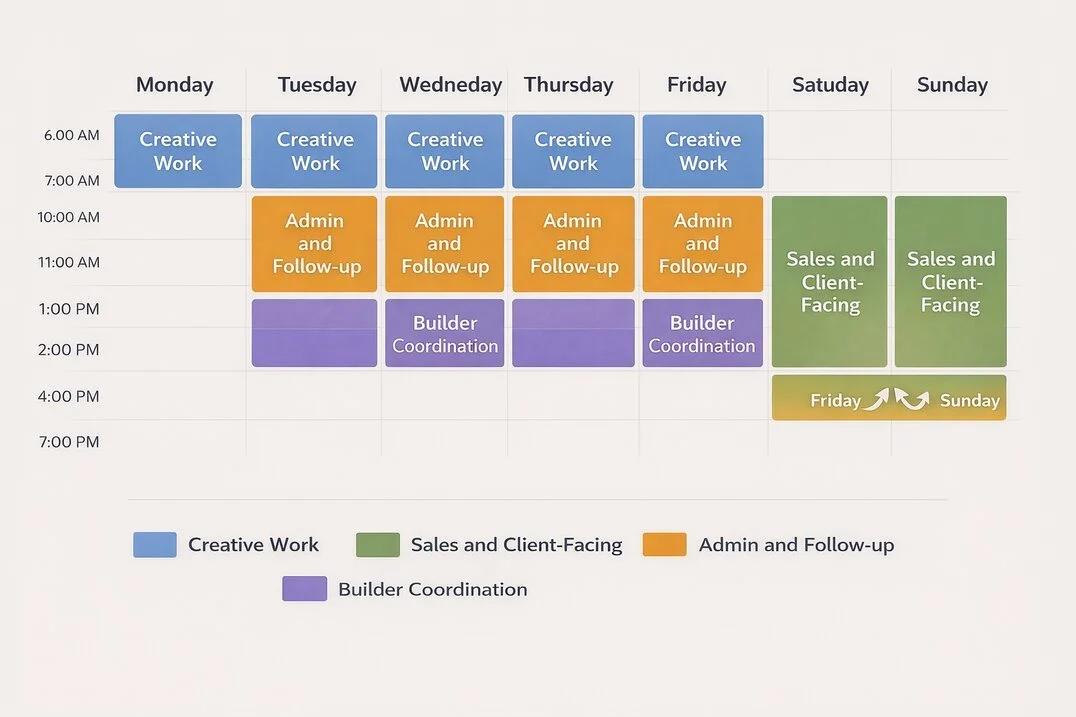
Chris lives by his Google Calendar, which his entire staff can see. This transparency allows them to slot in meetings and tasks without disrupting his flow. According to time management frameworks for professionals, this level of structure is essential for high performers. But more importantly, he emphasizes structuring your day around your own energy levels.
Creative work (morning): Chris arrives at the office a couple of hours before everyone else to handle creative tasks when his mind is fresh
Client-facing (weekends/peak hours): This time is reserved for sales and direct client interaction
Admin + follow-up (midweek): The middle of the week is dedicated to the "business" of real estate—lender follow-ups, coordinating with escrow, and managing the backlog of tasks
As Chris noted, a new home agent's job is only about 15 to 20 percent sales. The rest is managing your backlog, reselling the house to the client over the six-month build, and coordinating all the puzzle pieces. Without time blocking, the chaos will ensue. At Take Action Realty Group, we teach our agents the tools and strategies to stay organized.
Visual System – Weekly Time Blocking Framework for Agents
This framework shows how top agents structure their week. They dedicate specific days and time blocks to specific activities rather than reacting to whatever comes up. The result is higher productivity, less stress, and more predictable results.
AI in Real Estate: How to Use It Without Losing Trust
AI in real estate business operations has become a powerful tool, but it must be used as an enhancement, not a replacement. Chris's companies use AI daily for creative processes, systemization, and even software development to build better reporting tools.
For agents, he suggests using AI to get focused. "Ask AI, 'Here is what I do. What is my one thing to focus on?'" It can help you create a 30-60-90 day marketing plan, draft content, and streamline documentation.
However, the rise of AI has also highlighted the value of genuine human connection. In an era where emails and texts are automated, answering the phone and writing handwritten notes become superpowers. To see how Chris and his team integrate technology with personal service, visit his portfolio of companies.
Becoming a Value-Driven Real Estate Professional
To truly elevate your career, you must shift your mindset from salesperson to professional. Chris believes the industry has lost its way by focusing on "just listed" and "just sold" posts. These do not build value.
A real professional focuses on the client's outcome. They share the behind-the-scenes work. They talk about the 12 things they went through for a client that they never knew about. At Take Action Realty Group, we prioritize client-focused services and perks that make every transaction remarkable. When you start acting like a professional—solving problems and guiding people from where they are to where they want to be—you build value that cannot be undercut.
"If you want to win long-term, stop thinking like a salesperson and start acting like a professional who solves problems."
Why Agents Stay Stuck (and How to Break the Cycle)
Agents get stuck because they try too many things at once. They dabble in luxury, first-time buyers, and new construction all at the same time. They buy leads, try a new social media strategy, and exhaust themselves without ever mastering one path.
Chris's advice for breaking the cycle is clear. "Focus on one thing this quarter. That is it. One thing, and do not do all the other things and get really good at it."
For agents ready to break the cycle and build a focused strategy, Chris offers a Builder Strategy Session to map out a personalized path forward.
By focusing on a single specialization, you give yourself the time and energy to build the systems, relationships, and expertise that lead to predictable, scalable growth. This is how you go from chasing deals to having deals come to you.
Relationship Building Still Wins (Even in an AI World)
The most valuable competitive advantage today is something AI cannot replicate: a real conversation. Chris shared that one of his commitments this year is to write handwritten notes to other agents. The goal is simple: to say Thank you.
This simple act serves two purposes. It celebrates the professionals in the industry and acts as a quiet form of recruiting. It shows that you value the relationship beyond the immediate transaction. You can follow Chris on Instagram to see how he approaches relationship building in the industry.
If you want to be the agent that people want to work with, you have to do what 80 percent of agents will not. Answer the phone. Have a real conversation. As Chris noted, you cannot solve the world's problems over text. You cannot hear the tone or the intent. In a market saturated with automated touchpoints, a personal connection is the ultimate tiebreaker.
Want to go deeper into the strategies Chris shared about builder relationships, specialization, and time blocking? Listen to our full podcast conversation!
FAQ Section
1. Why is new construction a good opportunity for agents?
It offers consistent inventory in a variety of markets, often with simpler transaction processes handled by the builder. Most importantly, strong builder relationships can generate a steady stream of repeat business and referrals. According to market trends and development forecasts from the Urban Land Institute, new construction continues to be a growth sector in residential real estate.
2. What is the milk run strategy in real estate?
It is a proactive method of regularly visiting builder sales offices and communities. The goal is to build genuine, consistent relationships with on-site agents to gain insider access to deals and become their go-to partner for buyer referrals.
3. Should agents specialize in one niche?
Yes. Specialization is the key to scaling a business. It allows you to become a true expert, build efficient systems, and cultivate deeper relationships within a specific market, leading to more consistent and predictable growth.
4. How can I start building relationships with builders?
Start by identifying new communities in your area. Visit them consistently, bring value like coffee or lunch, and ask thoughtful questions. Be a resource and a collaborator, not just a competitor looking for a quick deal.
To build a truly sustainable real estate business, you must stop chasing every deal and start building a system that brings deals to you. Christopher Brown real estate developer broker author has spent over three decades proving that by mastering new construction, specializing in a niche, and prioritizing genuine relationships, you can create a career that is not only profitable but also enjoyable and predictable.
When Christopher Brown real estate developer broker author talks about specialization, he is speaking from hard-won experience. The principles he shared in our conversation apply whether you are just starting or looking to scale an existing business.
Apply to Be a Guest on the Why Do I Suck As a Real Estate Agent Podcast
Real estate is evolving. The strategies that worked yesterday may not work tomorrow. If you are actively working in the industry and solving real problems, whether in construction, finance, brokerage, or development, we would love to hear from you.
*This podcast is produced by the Icons of Real Estate - #1 Real Estate Podcast Network. For more resources on growing your show or refining your message, explore the podcast framework and read success stories from other industry professionals who have leveraged this platform or apply to be a guest.*
