
Scale Faster with Jess Lenouvel Using The Listings Lab Real Estate Marketing Model

Stop working 80-hour weeks for unreliable commissions. Switch to automated attraction marketing to build a scalable, profitable real estate career.
In a recent episode of Why Do I Suck as a Real Estate Agent, I sat down with Jess Lenouvel of The Listings Lab real estate marketing. We explored exactly how modern agents can stop chasing cold leads.
Here’s a short preview of our conversation:
Jess Lenouvel, founder of The Listings Lab and author of More Money, Less Hustle, fundamentally changed my perspective on running this brokerage. This guide helps you escape the hustle, use smart digital marketing, and boost revenue while saving time.
Watch the full episode:
Moving Past Old-School Cold Calling with Jess Lenouvel
When I launched this podcast, I had one question in mind: why do so many skilled agents feel completely stuck?
Over two and a half years of building Take Action Realty Group, I have watched talented people burn out trying to force an outdated model to produce results. Data from the National Association of Realtors consistently shows that a small percentage of agents account for the vast majority of all transactions. Most agents are not failing because they lack drive. They are following a model that was never designed for the way business gets done today.
Jess knows this firsthand. She got her license at 21, built her business through early Facebook when her entire Keller Williams office was pushing cold calls and door knocking, and scaled to a lean team closing 250 to 300 transactions annually. Then she walked away from production entirely to build a real estate agent training program that would become The Listings Lab. She has since trained more than 20,000 real estate professionals worldwide.
Her core argument is direct: if your business is breaking you, the model needs fixing, not your work ethic.
If you are serious about making this shift, understanding what it takes to build a real estate brand that genuinely attracts clients is the right place to start.
Unpacking the BetDar Decision Framework for Struggling Agents
Most brokerages respond to a struggling agent with more activity. More cold calls. More door knocking. More mailers.
Jess pushed back on that instinct immediately. Behavior is a symptom. The real breakdown happens earlier, at the belief level. She introduced a framework called BetDar to explain exactly where agents fall apart:
Beliefs shape Emotions. Emotions generate Thoughts. Thoughts drive Decisions. Decisions produce Actions. Actions determine Results.

If an agent carries a deep belief that real estate has to be brutal to be profitable, every decision they make quietly mirrors that belief. They resist efficient systems because ease feels like cheating. They reach for the phone book not because it is working, but because suffering feels like proof of effort.
HubSpot's ongoing digital marketing research shows that businesses investing in systematic, digital-first strategies consistently outperform those relying primarily on outbound prospecting. The challenge in real estate is that the industry spent decades glorifying the hustle, and that conditioning runs deep.
This same identity shift separates agents who scale from agents who plateau year after year. A conversation I had with real estate developer and broker Chris Brown explored exactly why the operators who grow fastest think differently about effort and efficiency.
Here is how the two mindsets compare in practice:
| Operational Pillar | Old-School Hustle Mindset | Modern Efficient Growth Mindset |
|---|---|---|
| Lead Generation | Manual outreach: cold calling, door knocking, mass mailers | Inbound attraction through hyper-targeted digital media |
| Time Allocation | 60-80 hours per week, always on-call, wearing every hat | Focused 3-4 hour productive workdays with strict boundaries |
| Technology Adoption | Manual spreadsheets, social media used as a billboard | Automated workflows, AI-assisted content, retargeting campaigns |
Deploying the ROI Method to Attract High-Value Real Estate Clients
The centerpiece of everything Jess teaches is a proprietary framework built to replace manual prospecting entirely. Jess teaches a proprietary real estate client attraction framework, replacing manual prospecting and ensuring qualified clients come to you.
Most agents hear ROI and think return on investment. Jess redefined it.
"ROI stands for relevancy, omnipresence, and intimacy. Those are kind of the three pieces that you need to nail in order for your digital marketing to perform and to be, frankly, unlimitedly scalable. This is how you build that ongoing tap of clients that you can control. Relevancy is who are you speaking to and do you understand their pains, problems, fears, and desires? The omnipresence piece is taking a relevant message and putting it everywhere so that they feel like everywhere they go, they're seeing your message and your name. The intimacy piece is the relationship... I'm actually a real human being that's connecting with you online."
The first pillar is Relevancy. Generic agents who market themselves to anyone buying or selling are functionally invisible online. The algorithm cannot categorize them. Potential clients cannot feel seen by them. The more vanilla the message, the less the content performs.
Niching down is not a limitation. It is a targeting strategy. Whether the focus is suburban upsizers, first-time investors, or a specific neighborhood demographic, there is more than enough business in any defined niche to sustain a thriving practice. Jess's real estate agent business planning framework walks through how to identify and build around that niche from the start.
The guiding question shifts from what you want to say to what your ideal client needs to hear today. That reframe alone separates content that gets ignored from content that generates inbound inquiries.
Building Digital Omnipresence and Intimacy Without Losing Authenticity
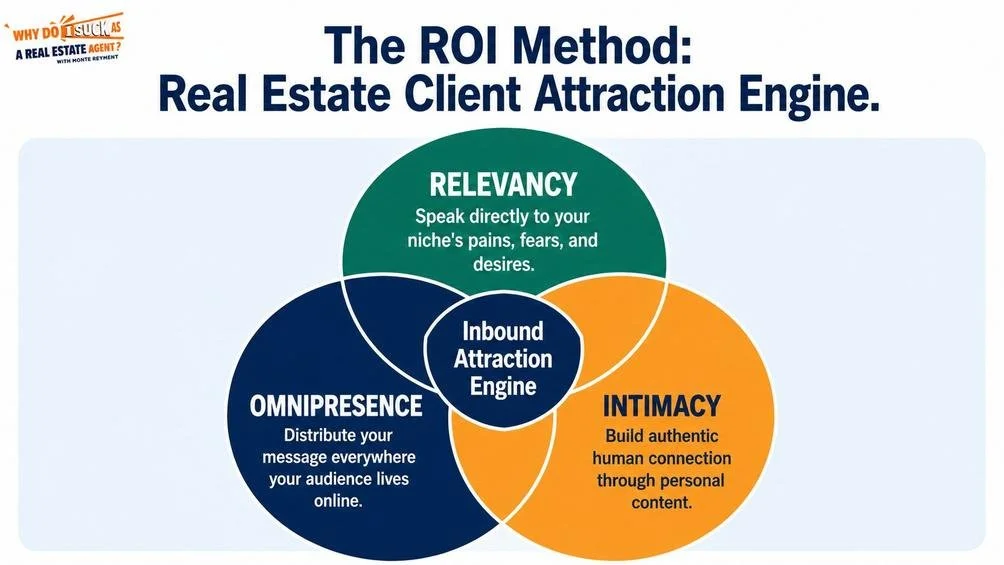
Once you have a relevant message, the second pillar scales it. Omnipresence is not about posting content around the clock. It means using retargeting campaigns, email nurture sequences, and organic social channels strategically, so your target audience sees your name and expertise wherever they are online.
Jess offered a sharp warning here. Omnipresence without relevancy does not build a brand. It just irritates people.
Research on how social media algorithms distribute content confirms what Jess describes. Platforms consistently reward content that sparks genuine engagement and suppress content that reads as purely promotional. Meta has now categorized standard "Just Listed," "Just Sold," and open house graphics as spam content, which explains why so many agents have watched their reach quietly decline without understanding why.
The third pillar, Intimacy, is where most agents are genuinely failing. Their profiles are packed with award graphics, production milestones, and corporate listing templates. There is no personality in it. No philosophy. Nothing that makes a stranger feel like they know this person.
Jess made the point sharply when one of her students said she was a private person and did not want to share personal content. Jess's response was direct: you are asking people to share their deepest financial details and invite you into their home. Withholding your own story while asking for that level of trust does not work.
When a prospect feels like they already know you before the first phone call, you have effectively pre-closed the deal.
Using HGTV-Style Case Studies Instead of Boring Just Sold Graphics
If billboard-style posts are hurting your reach, how do you still demonstrate that you are an active, producing agent?
Jess pointed straight to HGTV.
The entire network runs on case studies. Not property photos. Not agent headshots with award logos. Human journeys. People do not connect with a static image of a house. They connect with the story behind it.
"Every time you have a just sold, instead of posting a just sold, you post a case study, you tell the story. You take someone through the journey from start to finish, and you allow them to live vicariously through that client that you just helped through this process. Not only are you telling a story, you're emotionally connecting with the people who are in that same situation or that same position, but you're also highlighting the things in your process that you do regularly that made everything go smoothly. Stories are twenty-two times more memorable than facts."
This shifted how I think about client content at Take Action Realty Group.
We are currently rebuilding our website, and I had already planned to feature video testimonials. After this conversation, I realized a client saying "Monty was great" accomplishes nothing. There is no conflict, no journey, no resolution. The story worth capturing covers where the client started, what obstacles came up, how we solved them together, and where they ended up.
The carousel format on social media is purpose-built for this. Each slide carries the story forward and keeps the viewer engaged through to the end. Jess's breakdown of how storytelling drives real estate client attraction covers exactly how to structure these narratives so they generate consistent engagement and inbound leads.
This principle holds beyond social media. Content marketing research on narrative-driven strategy consistently shows that story-based content outperforms purely factual content in both engagement and long-term recall. The 22x memorability advantage Jess cited is well-established across service industries.
Agents who build genuine local authority understand this intuitively. It is the same reason why practitioners like Alison Alston at Lodestone Real Estate build brands that resonate rather than brands that simply blend into the feed.
Eliminating Administrative Inefficiencies Through Intelligent Automation
Many agents assume that automation means turning their brand cold and robotic. Jess draws a clear line.
Never automate the actual human conversation. Automate everything that should not require a human in the first place.
Every booking confirmation. Every follow-up sequence. Every data entry task. Every piece of content scheduling. These are not relationship-building activities. They are button-clicking tasks that purpose-built software handles better, faster, and cheaper than a person does.
Jess pointed out that many teams have salaried positions at $30,000 to $50,000 a year doing work that dedicated software handles for a few hundred dollars annually. Modern real estate automation and AI systems make this possible. AI tools manage busywork, letting you focus on the human side of business.
The goal is not to eliminate those people. It is to redirect their energy toward client-facing, revenue-producing work.
The framework she applies is Eliminate, Automate, Outsource.
Identify every task consuming time without producing income. This is the blueprint for scaling a real estate business without burnout. When you eliminate low-value tasks, automate repetitive workflows, and outsource what remains, you stop being the bottleneck and start operating like a scalable business instead of a solo practitioner running on fumes.
Jess put it plainly: Would you pay thirty dollars to spend two extra hours with your kids on a Friday afternoon? Of course you would. So spend the time up front to build the system that makes that possible.

Reworking My Operational Systems After Talking with Jess
This conversation hit close to home.
Even as an experienced broker handling a high volume of transactions, I had been defaulting to minor administrative tasks that a well-built system could handle automatically. Not because I lacked the tools. Because I had never stopped to build the system, and somewhere along the way I had internalized the belief that busyness equals productivity.
Last week I used AI tools to clear my entire administrative backlog by Friday afternoon. My first instinct was to find more work just to prove I was grinding. Jess named that feeling precisely. The guilt of finishing early is a manufactured industry habit, not a measure of success.
The book she wrote, More Money, Less Hustle, is built around exactly this principle. She wrote it because she could not find a real estate resource she could wholeheartedly recommend to the agents she works with. It walks through the operational pillars of a profitable, efficient practice and how to restructure each one so the business works for you rather than against you.
The real measure of a thriving modern agent is not surviving an 80-hour work week. It is hitting financial targets while preserving the space to step away, invest in your health, and spend meaningful time with the people who matter.
Jess ended the conversation with a line worth carrying into every decision you make about how you spend your time. Results do not take time. They take courage.
Want to hear Monte Reyment and Jess Lenouvel break down how to replace hustle culture with the ROI Method? Listen to our podcast episode.
Frequently Asked Questions
What is the ROI Method real estate strategy created by Jess Lenouvel?
The ROI Method is a real estate digital marketing strategy developed by Jess Lenouvel at The Listings Lab. ROI stands for Relevancy, Omnipresence, and Intimacy. Relevancy means understanding a specific niche's pain points, fears, and desires well enough to speak directly to them. Omnipresence means distributing a consistent message across every digital platform your target market uses. Intimacy means building genuine human connection through personal, value-driven content that makes prospective clients feel like they already know you before the first conversation.
Why is Meta penalizing traditional real estate marketing posts?
Social media platforms including Meta have categorized low-engagement promotional posts, such as standard "Just Listed," "Just Sold," and open house graphics, as spam content. These posts do not generate meaningful community interaction or provide consumer value, so the algorithm systematically suppresses their organic reach. Agents whose accounts consist primarily of billboard-style content are losing visibility without understanding the cause.
How can real estate agents automate their workflows without sounding robotic?
Agents should limit automation to back-end operational tasks: email capture, appointment confirmations, file management, content scheduling, and follow-up sequences. All client-facing communication should be written in the agent's natural conversational voice and tailored to each audience segment. The goal is for the back-end automation to be completely invisible to the client while freeing the agent to focus entirely on direct, human-to-human interactions.
Apply as a Guest Speaker
The real estate industry is undergoing a fundamental structural shift. Old-school prospecting tactics are losing their effectiveness. Consumer expectations are higher than ever. Advanced technology is rewriting how transactions happen.
Survival in this environment means replacing brute-force hustle with intelligent systems, precise market positioning, and scalable digital workflows.
If you are an active real estate professional currently solving real operational problems, navigating these shifts, or building innovative business models in today's market, I want to hear your story.
