Nic Williams: Building The Alaskan Realtor Brand Through Technology, Niche Focus & Business Ownership
What separates a real estate agent who just fills transactions from one who builds a legacy? It's not a hustle alone. It's a deliberate mindset shift: treating your license as a business license, building a brand that outlasts any single deal, and leading with value rather than chasing commissions.
I have had a lot of great conversations on the Why Do I Suck As a Real Estate Agent podcast, but my sit-down with Nic Williams, a broker and founder of The Alaskan Realtor brand in Fairbanks, Alaska, was something else. Nic broke down exactly how he built one of the most recognizable real estate brands in the country from one of its most isolated markets, and the lessons apply everywhere.
Link to Full Episode: Mastering Real Estate with Technology and Strategy - EP 05
Who Is Nic Williams, and Why His Perspective Is Different
Nic is a former U.S. Army officer, Virginia Military Institute graduate, and combat veteran who deployed to Afghanistan in 2013. When he left the military, real estate was never the long-term plan.
“Real estate was supposed to be a temporary holdover job. It was supposed to be a skill that I wanted to pursue in order to get into flipping and business in general. But it turned out I actually liked the negotiation and business side of real estate more than I thought I would. I stuck around a lot longer than I thought I would, and now six years later, I’m a broker trying to open up my own brokerage in the near future.”
Six years and roughly 650 transactions later, Nic has been named Fairbanks' Top Realtor for 2021, 2022, and 2023. I could hear his military discipline in everything he said. The strategic thinking he developed in the field translates directly into how he runs his business.
His expertise spans the entire Fairbanks North Star Borough, from military families near Eielson AFB to investors buying multifamily properties.
The Three Generations of Realtors — And Who Has the Advantage
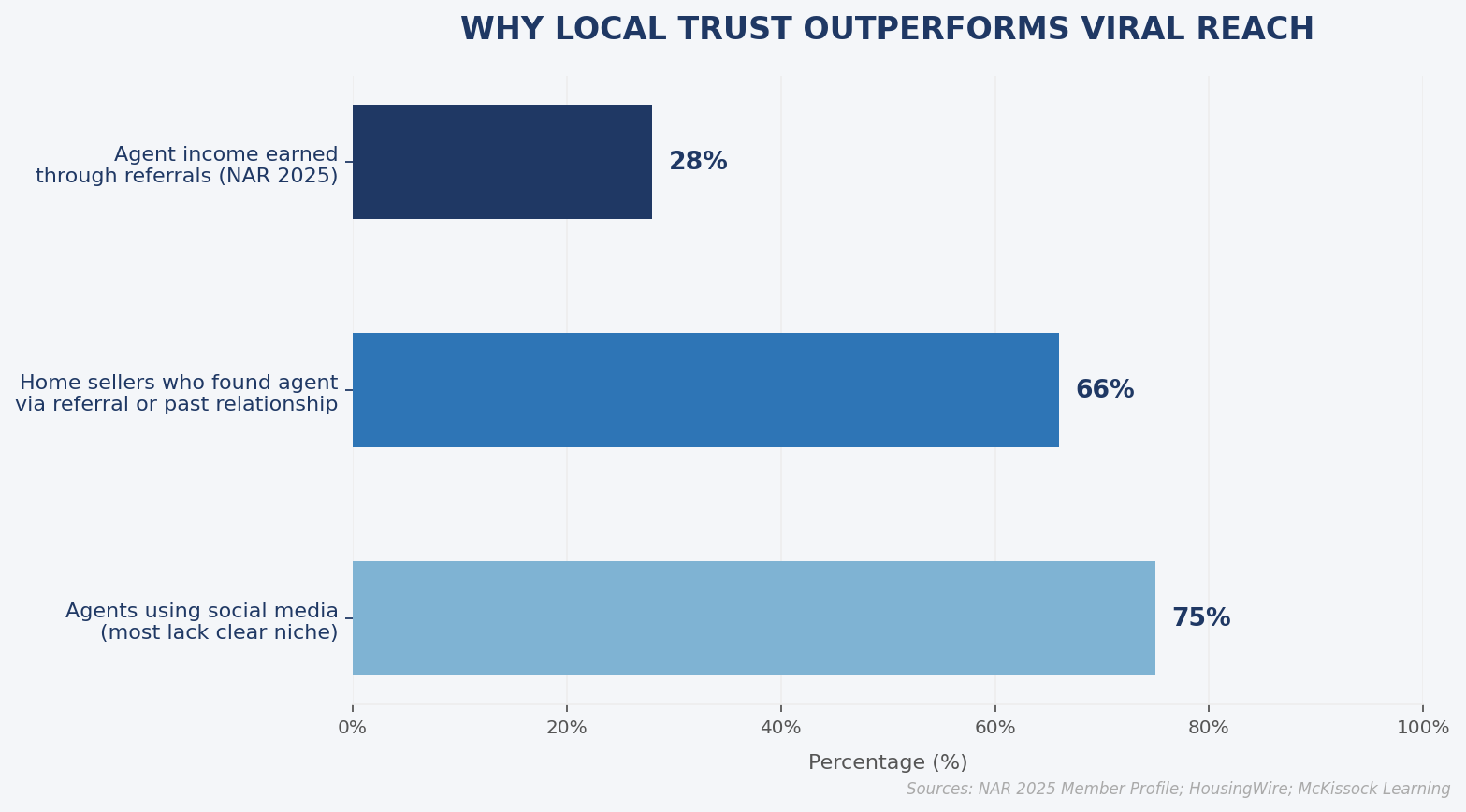
Nic does not sort struggling agents by experience level. He sorts them by generation. The NAR 2025 Member Profile backs him up — seasoned agents earn 28% of their business from referrals alone, proof that sphere of influence compounds over time.
“These young people understand technology and social media. They just don’t have the connections. The older people have the connections but don’t understand the internet. And then us — 30 to 50 year olds — we know people, and we know the internet. Technology and personality coming together is what creates brand, reputation, and top-of-mind awareness.”
As someone in that middle generation myself, I felt this one. Here is how the three groups break down:
• Younger agents: Strong on social, but thin on relationships and sphere of influence.
• Older agents: Deep networks, but struggling to compete digitally.
• Middle generation (30–50): Connected both offline and online — the sweet spot for long-term growth.
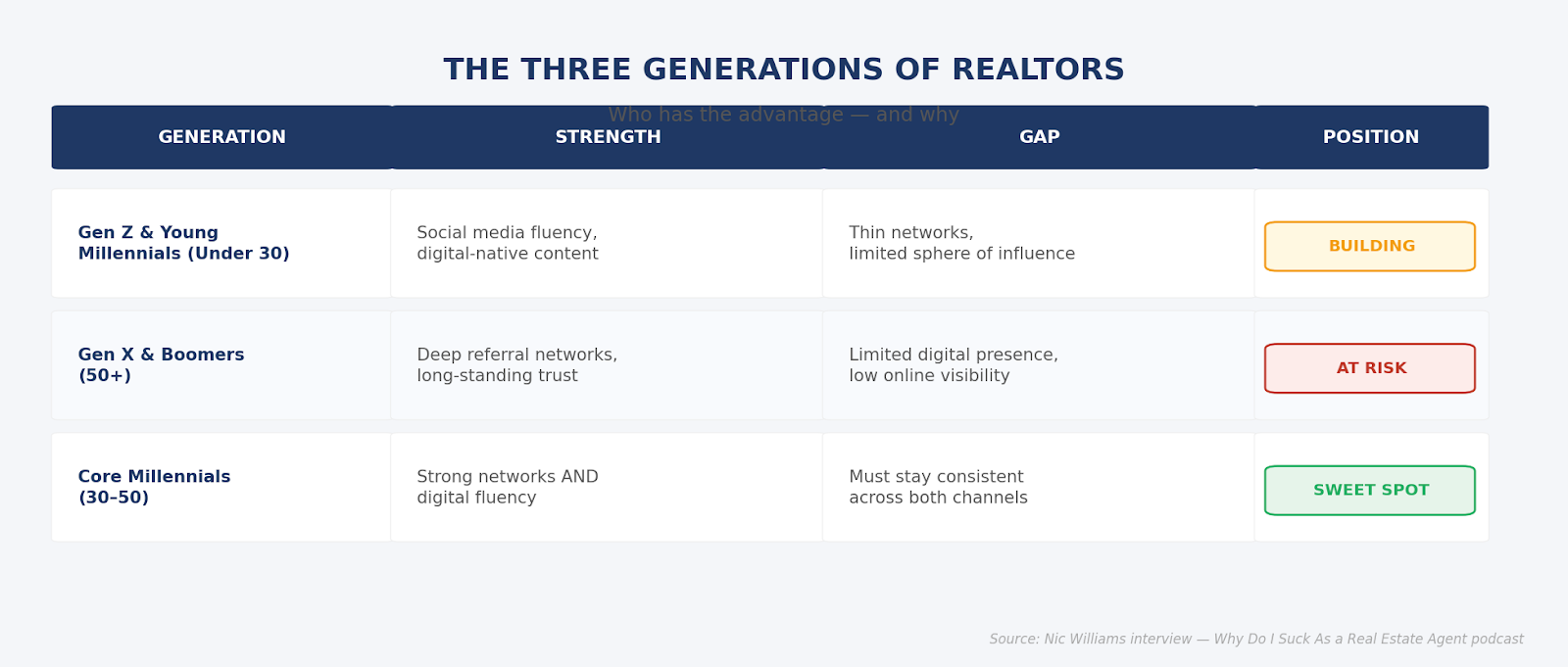
The agents who combine personality with technology are the ones building careers that last. That combination drives name recognition and consistent referral income.
Building 'The Alaskan Realtor' — Why Branding Beats Hustling
Nic did not just pick a business name. He built a full alter ego, and the separation is completely intentional.
“I’m The Alaskan Realtor. It’s my superhero mantra, if you will. I’m not Nic Williams. Nic Williams is the guy who sits at home with his Doberman and watches movies. The Alaskan Realtor is the guy on the internet trying to educate people and give away knowledge for free.”
The name is also a smart SEO play. Anyone searching for an Alaska real estate agent runs straight into his content. His platform strategy is equally deliberate: Facebook is for community, Instagram is for your following, TikTok is for authenticity, and LinkedIn is for professionals. McKissock Learning reports that 75% of agents use social media to build their brand, but most fall short due to inconsistent posting and no clear niche. Nic avoids both traps.
“Everything comes back to value. If there’s no value in your post, don’t post it.”
Providing value first, without expecting anything back, is the foundation every strong real estate brand is built on. For a deeper breakdown of how to build that visibility through search, check out my post on SEO for real estate agents.
Nic's approach to branding is exactly why I love featuring guests on this show. If you are thinking about launching your own podcast to build authority, Icons of Real Estate handles production for agents nationwide.
Niche Marketing — Why You Cannot Sell Everything to Everyone
Nic built his practice around two focused niches: military relocations and multifamily investors. He did not chase everything.
“For me, it’s relocations — anybody in the military coming up here, people trying to escape the lower 48 and move to Alaska, and then multifamily investors. If I did luxury, I’d go broke. If I did flipper construction properties, I’d be too busy doing the work instead of selling.”
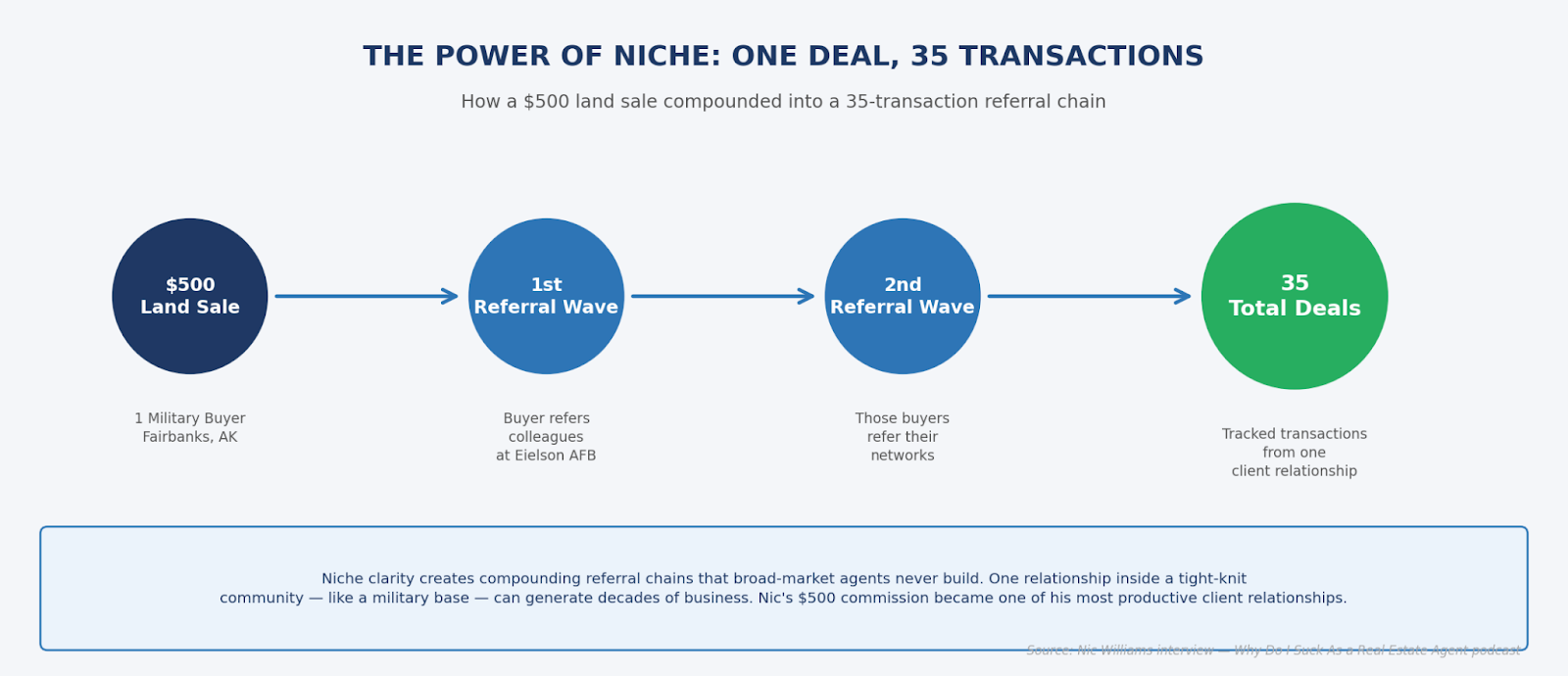
That niche clarity compounds. Nic told me about a $500 land sale that eventually generated 35 connected transactions through a single military referral chain.
If you work with investors or want to start attracting that niche, my post on becoming an investor-friendly real estate agent walks through how to position yourself for those deals.
From Agent to Business Owner — The LLC Mindset Shift
This is something I push hard on, too. The moment you get your license, you are not just an agent. You are a business owner. Nic put it plainly.
“Everybody should be operating underneath an LLC. There are a lot of legalisms in real estate. It’s only a matter of time before somebody gets sued. By working underneath an LLC, you’re protecting your private assets.”
And the tax side of it is just as important.
“When you’re a normal person, you get paid, you get taxed, and then you spend what’s left. With a business, it’s the other way around. You get paid, you spend on your business, and then you get taxed on the profit.”
The IRS outlines business structures for self-employed individuals that every agent should review before setting up their entity. Always work with a CPA who understands real estate.
Common real estate tax write-offs worth discussing with your CPA:
• Cell phones, cameras, and laptops used for work
• Heavy-duty vehicles over 7,000 lbs (Section 179)
• Home office square footage and business mileage
“Take your MLS stats and drop the PDF into ChatGPT. Then turn on the microphone and talk your way through the house — literally describe the floor plan out loud. Now the AI has a visual. Then tell it to write in a storytelling style without HUD violations or taboo vocabulary.”
That voice-to-AI approach gives the model real spatial context. Layer in your tone preferences, ban overused words like "nestled," and remove m-dashes. Those two things alone will make your descriptions look and feel far more human.
“People don’t need you to regurgitate the price and the address. That’s already in Zillow. Tell the emotional story of how someone’s lifestyle will look in that house.”
The structured approach Nic uses for his content mirrors the podcast framework I've seen work for dozens of guests on this show.
“The same value you’re providing to clients online is what you want to provide your agents in the office. I focused on new agents who needed coaching and training. But I don’t want someone who needs their hand held — I want someone who wants to surpass me.”
He uses DISC analysis to understand each agent's personality and tailors his communication accordingly. The goal is for his agents to eventually outperform him. That is not something to fear. That is what great leadership looks like.
The Three E's of Real Estate — Nic's Core Framework
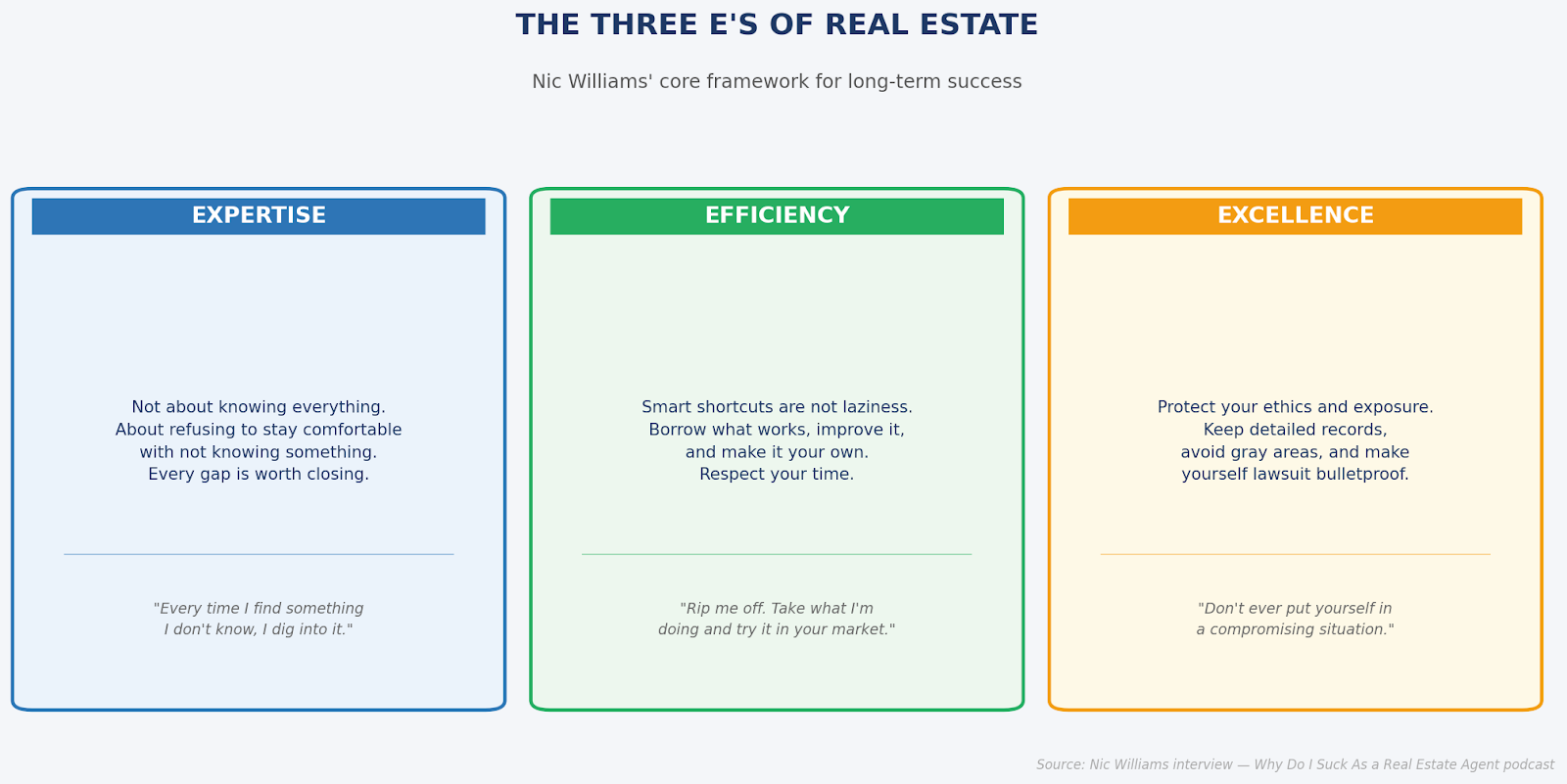
“Expertise doesn’t mean you know everything. It means you’re not satisfied with not knowing something. Every time I find something I don’t know, I dig into it.”
Expertise is a mindset. Every knowledge gap is worth closing, whether it is a tax form, a negotiation tactic from Never Split the Difference, or a new SEO strategy.
“If I can take a shortcut, I’m going to take a shortcut. Theft isn’t theft if you make it better. Rip me off. Take what I’m doing and try it in your market.”
Efficiency is not laziness. It is respecting your time enough to borrow what works and build on it. I love that Nic says this out loud because it is true.
“Don’t ever put yourself in a compromising situation. This industry is riddled with lawsuits. Make yourself lawsuit bulletproof.”
Excellence comes down to protecting your ethics and your exposure. Keep detailed records, avoid gray areas, and guard your local reputation above everything else.
Reputation vs. Viral Fame — The Social Media Balance
“What you don’t want to do is hurt your reputation locally because you’re trying to build a nationwide brand that isn’t going to help you.”
Viral content gets clicks, but in real estate, trust closes deals. HousingWire reports that 66% of home sellers found their agent through a referral or past relationship — not a viral video. I have seen agents mock a seller's home for engagement. Those are real people's houses. Your local credibility is harder to build than a following, and it is worth far more.
Frequently Asked Questions
Who is Nic Williams, The Alaskan Realtor?
Nic Williams is a REALTOR and broker with Summit Realty Group in Fairbanks, Alaska. Named Fairbanks' Top Realtor in 2021, 2022, and 2023, he runs The Alaskan Realtor brand across web and social platforms, focusing on military relocations and multifamily investment.
Should real estate agents form an LLC?
Yes. An LLC separates your personal assets from business liability and unlocks pre-tax spending advantages. Work with a CPA who understands real estate business structure before setting one up.
How can AI help with listing descriptions?
Use voice input to walk ChatGPT through a property's layout, then prompt it to write an emotionally driven MLS description free of HUD violations and cliche language. Train it on your tone over time for consistent, on-brand output.
What are the Three E's of real estate?
Nic's framework: Expertise (always learning), Efficiency (smart systems and shortcuts), and Excellence (ethical, lawsuit-proof practice).
How do you build a real estate team culture?
Lead with the same value you provide your clients. Focus on mentorship over management, tailor communication to each agent's personality, and recruit people who want to outgrow you.
The Takeaway
Talking with Nic Williams reminded me of why I started this show. The agents who win are not the ones working the hardest. They are the ones thinking the clearest. Nic built The Alaskan Realtor in one of the most isolated markets in the country by staying niche, owning his business structure, and leading with value. Follow his work at nicwilliamsrealtor.com.
Want to hear my entire conversation with Nic? We went deep on military discipline, AI workflows, and what it really takes to build a brand in an isolated market.
Nic joins a growing list of agents scaling their influence through content. Read more agent success stories from others who have been on the show.
Apply to Be a Guest on the Why Do I Suck As a Real Estate Agent Podcast
Real estate is evolving. Capital is shifting. Markets are tightening. If you are actively working in the industry and solving real problems, whether in brokerage, investment, technology, or development, I would love to hear from you.
*This podcast is produced by Icons of Real Estate — the #1 Real Estate Podcast Network. Find more episodes at the Icons Hub.
