
Jason Mickelson, Century 21 Des Moines: Mastering Communication, Body Language & Buyer Conversion in Real Estate
Jason Mickelson sold cars for 13 years before he ever showed a house. When he came on the Why Do I Suck as a Real Estate Agent podcast, he told me that background gave him one thing most agents never develop: the ability to watch a buyer's shoulders drop when they walk into a room they actually want. As a team leader at Century 21 Des Moines, he's turned that instinct into a repeatable system.
His real estate communication skills show in everything from the questions he loads before a showing to the way he reads a buyer's posture mid-tour. He doesn't wing it with clients, and it shows.
That same level of intentionality is the standard we prioritize at TA Realty Group. We’re constantly learning from pros like Jason to better serve our clients—join our community on LinkedIn and Instagram for more insights and conversations that go behind the scenes of the industry.
Who Is Jason Mickelson & Why Communication Is His Edge
Jason spent 13 years in the automobile industry before joining real estate in 2017. The man who originally trained him in car sales had left years earlier to buy a brokerage in Ames, Iowa. Jason eventually followed him over, and that automotive background gave him something most new agents lack: thousands of reps in face-to-face selling before his first showing.

“In the car business, you’re helping people buy their transportation. It’s a wonderful way to make a living, but real estate was a natural progression. Now we’re helping them with the biggest purchase of their lives. One of the things I focus on heavily is buyers. I love watching a buyer’s face light up as they look through a house and see that it’s going to be a good fit, or even when they rule it out and we go back to the drawing board to figure out what will work. What drives me is how much the clients respond and enjoy the process if you do it right.”
That last line is the one I keep coming back to. The clients enjoy the process if you do it right. Most agents never hear that feedback because they're rushing through it. It's a mindset I look for when I'm building out my own team.
Why Body Language Is 60% of Communication
I've watched agents scroll through MLS on their phones while their buyer is having an emotional reaction to a kitchen layout. Jason trains his team on a stat backed by decades of nonverbal communication research: body language is the largest channel of human interaction.
“When I train people, I tell them there are three types of communication, and body language is the largest one. We focus a lot on text messages and phone calls, but 60% of communication is body language. If you’re just worried about the house—I care about the house, but I’ve seen a lot of houses. I’m more worried about whether they are excited or if they are sitting there saying, ‘I’m not happy with that.’ So many people are missing it because they’re on their phones while showing a house. Your phone is not important in that moment; the reaction of your client is.”
I've lived this. During COVID, I pulled a couple out of a ranch house mid-showing to talk in the driveway. They thought they liked it. It didn't check a single box on their list. Knowing how to read buyers during showings saved them from a bad purchase.
Don't Enable — Empower Buyers Through Education
There's a trap Jason identified that I see constantly: agents who shut a buyer down the moment they say something unexpected. A buyer mentions a neighborhood outside their budget, or fixates on a feature that conflicts with their priorities. The instinct is to correct them. Jason takes the opposite approach.
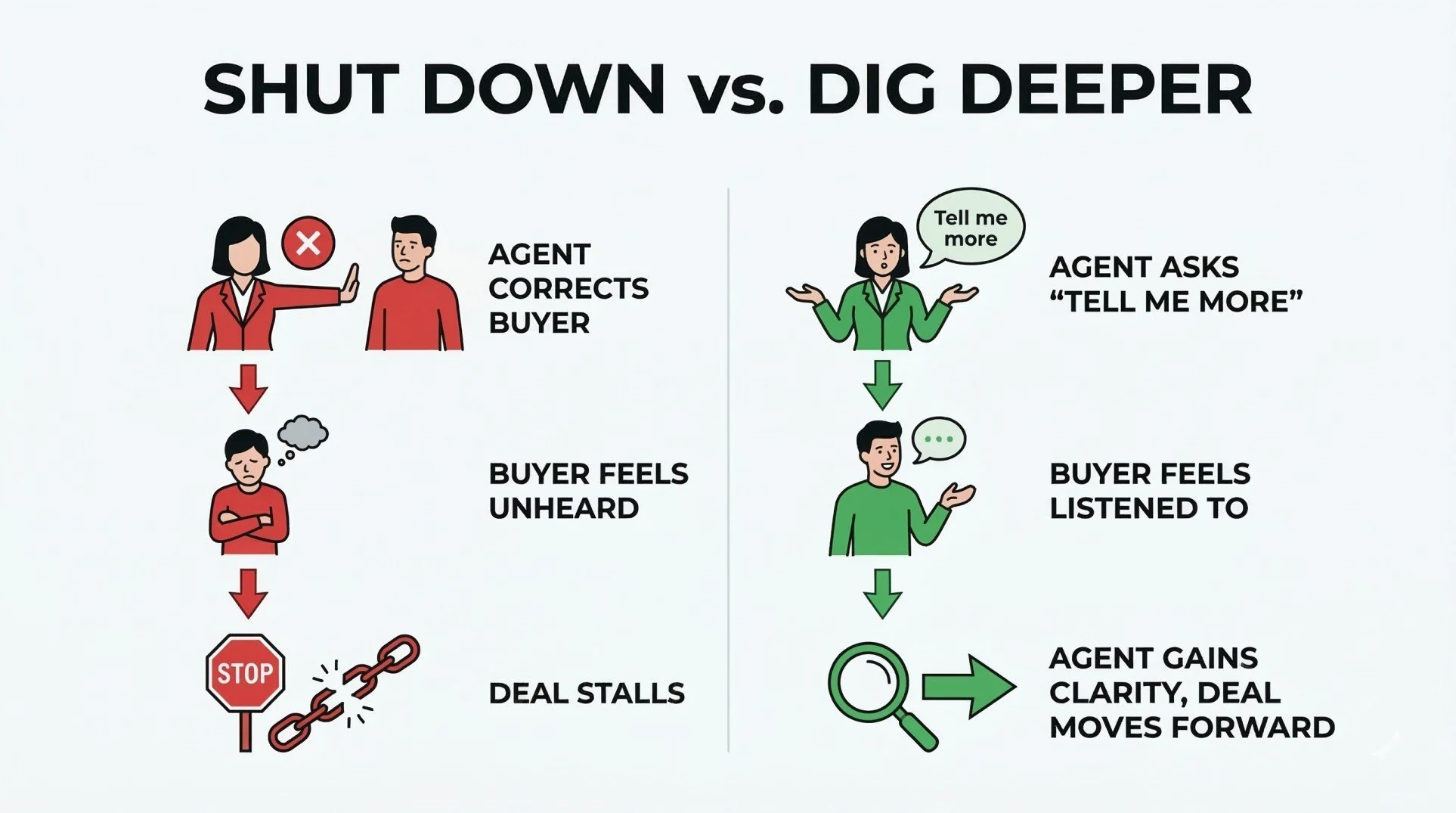
“One of the things that separates us is avoiding the trap of telling people what they can’t do. Naturally, salespeople often just shut people down, and the client doesn’t feel listened to. The best thing we can do when they say something crazy is treat it as an objection and ask, ‘Tell me more.’ I like to use my body language to show curiosity. I need more information to get on the same page.”
The goal is getting buyers to the right decision on their own terms. I tell my agents the same thing: you'll arrive at the answer faster than your buyer will. You've seen 500 houses; they've seen five. Real estate client communication means walking them through the process so they reach the closing table confident in the choice. I explore this approach in depth on our blog.
Questions Beat Scripts — Why Curiosity Wins
Jason doesn't use scripts. He builds each real estate buyer consultation from scratch using SPIN Selling, the framework from Neil Rackham's book, which organizes sales questions into four categories: Situation, Problem, Implication, and Need-payoff.
““I start each client with a blank canvas. I can’t understand their needs if I know nothing about them. But if you play ‘20 questions,’ people get frustrated. You want to visit with them conversationally. Through questions, I paint a picture in my brain. Often, after one or two homes, I can say, ‘I have the perfect house for you; it’s not on your list, but based on what I’ve learned, I think you’d like it.’ And they buy it.””
The gap between new agents and experienced ones usually comes down to which questions they ask. Situation and problem questions feel like an interrogation. Implication and need-payoff questions make the buyer say their motivations out loud, and once they do, the deal moves.
| SPIN Question Type | Purpose | Real Estate Example |
|---|---|---|
| Situation | Understand current facts | How long have you been searching? |
| Problem | Identify pain points | What has been the hardest part of your search so far? |
| Implication | Explore consequences of inaction | If you wait another six months, how does that affect your timeline? |
| Need-payoff | Let the buyer state the value | If we found something that checked those boxes, what would that mean for your family? |
Why Agents Struggle — Lack of Repetition & Training
Jason made a comparison that stopped me cold. In car sales, you might move 20 vehicles in a single month. In real estate, most agents are trying to close 20 deals across an entire year. That gap in repetition is where skill development stalls.
“Most people in sales have never had real sales training or repetition. In the car business, you might sell 20 cars a month. A real estate agent might try to sell 20 in a year. Because you’re only doing 20-30 deals, it’s hard to learn. You have to educate yourself. A lot of what we do every day is pointless—things we say or ask just by habit.”
Industry data from the National Association of Realtors confirms that the median transaction count for agents remains low. Without intentional practice, those few deals never compound into actual skill improvement. Real estate sales training is what Jason Mickelson emphasizes at Century 21 Des Moines: study what works, study what doesn't, and stop running on autopilot.
Negotiation Strategy — Be Willing to Walk
By the time Jason reaches the offer stage, his clients already trust him as an advisor. That trust gives him room to execute real estate negotiation tactics grounded in discipline.
“Many people don’t have the stones to be willing to walk away. Walking away doesn’t have to be forever; it could be for 12 hours while you revisit the situation. By the time we reach negotiations, my clients look at me as a trusted advisor. They ask what we should offer. I go back to: what is the market saying? What is the normal discount? How long has the house been on the market? I like to write an offer that is just low enough that it hurts for the seller to take it, but not so low that they are insulted.”
I had a buyer who wanted to go $50,000 under asking on a new build listed for ten minutes. Because I had a relationship with the listing agent, I called her directly and asked her to keep it alive. He got a $5,000 discount. Without that call, she would have rejected it outright. The relationship was the leverage.
Lead Conversion — Stop Waiting for Buyers
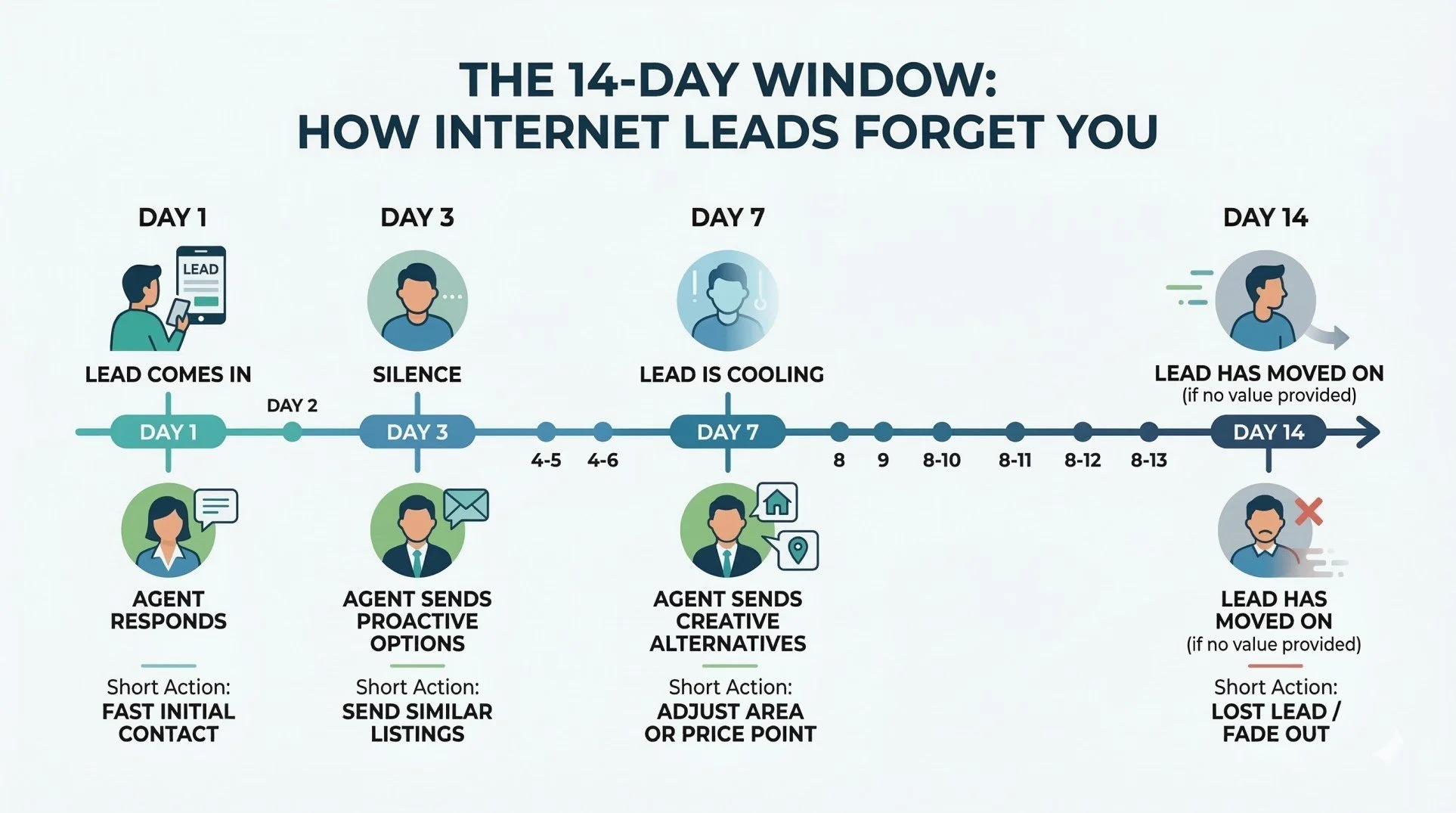
Jason's real estate lead conversion tips are blunt, and earned. The default mode for too many agents is passive: wait for the buyer to reach out, then react. He flips that entirely.
“You are not an order taker at Wendy’s. In real estate, we aren’t just waiting for them to tell us what they want to buy; we should be putting options in front of them. The worst question you can ask is, ‘Are you ready to look at houses?’ Of course they are. If you haven’t heard from them in three days, you need to think outside the box—different areas, different price ranges, maybe a house with a basement they can finish. If you aren’t sending them options, you won’t stay in front of them. Internet leads will forget you in two weeks if you aren’t providing value. Give to get.”
That's how you stay visible when a lead has 15 other agents in their inbox.
Give to Get — The Conversion Multiplier
Jason's core philosophy is value-based selling in real estate: give to get. Provide value before you ask for anything. I've built my own practice around the same principle. I've shown people ten houses only for them to decide to rent for another year. That's fine. The ones who come back remember who gave them time without an agenda.
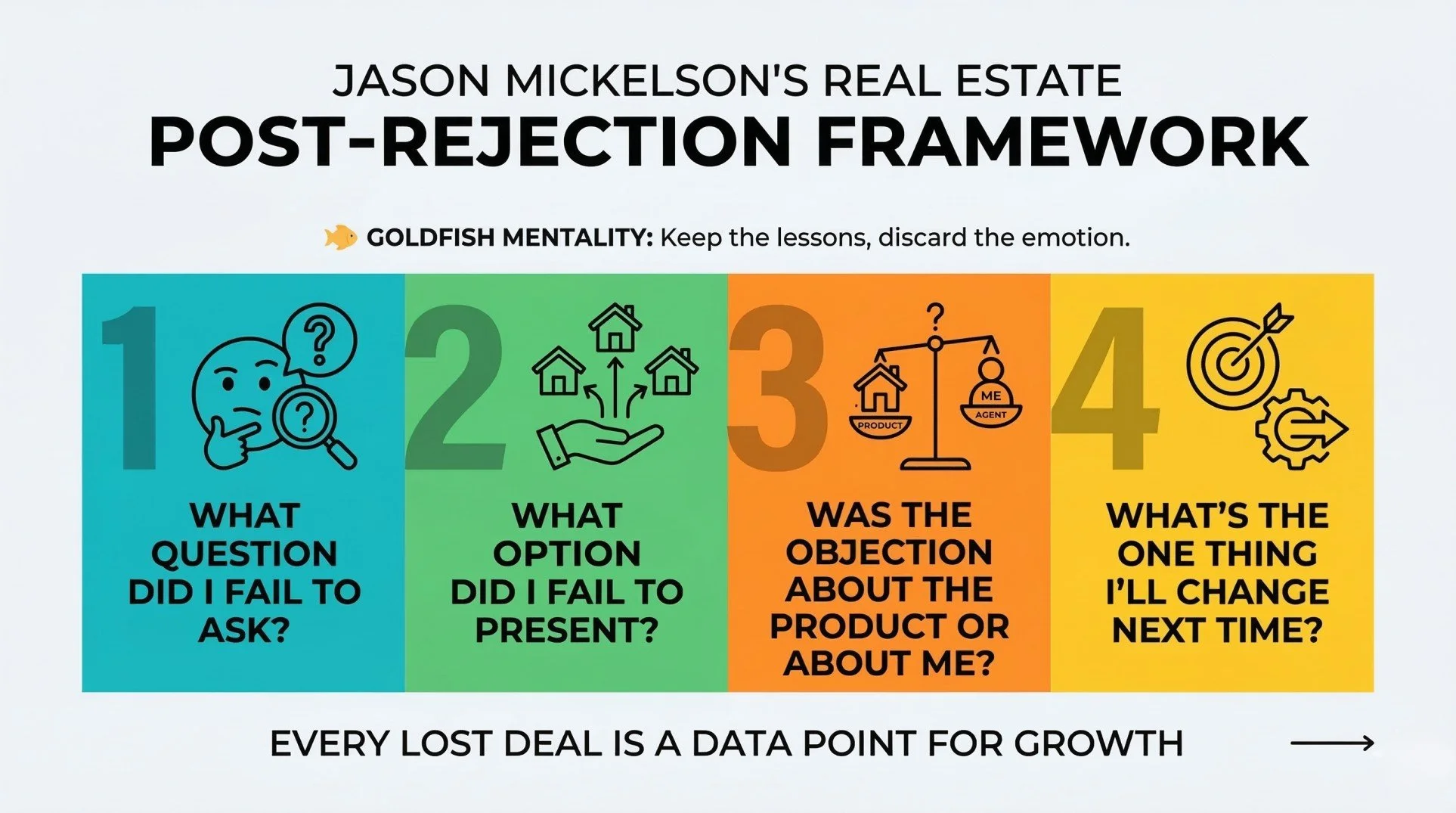
Handling rejection in real estate is where Jason's goldfish mentality kicks in. Short memory. Learn the lesson, discard the emotion, and move on.
“I’m a goldfish. Most people aren’t. In sales, you need a very short memory. Keep the valuable lessons, but throw the negativity in the trash immediately. I dissect the bad stuff to learn, but I don’t repeat it. A bad salesperson will grumble for an hour about a ‘bad client’ who didn’t buy. The reality is we should ask: ‘What could I have done differently? What question did I not ask? What home did I not put in front of them?’ They didn’t say no to you; they said no to the product.”
Self-accountability separates agents who grow from those who stall. Here's how Jason frames his post-rejection audit:
What question did I fail to ask?
What option did I fail to present?
Was the objection about the product or about me?
What's the one thing I'll change next time?
Final Advice — Do More Than You Think You Need To
Jason closed our conversation the same way he runs his business: direct, no fluff, and centered on effort. "If you think you've called, texted, and emailed enough, you haven't," he told me. "Get on the phone, get in front of your computer, and do the work. And don't forget: give to get. Make it all about the client."
I tell every agent who joins my team that this business requires three things: patience, consistency, and curiosity. Real estate consistency habits separate the agents who build careers from those who burn out in two years. It's a theme I come back to constantly, including on Selling Wisconsin ADTV. You have to treat every single month like it matters, because it does. Jason lives those principles every day.
Frequently Asked Questions
Who is Jason Mickelson of Century 21 Iowa?
He's a team leader based in Des Moines and Ames who transitioned from automobile sales to real estate in 2017. He mentors agents on communication, buyer conversion, and negotiation.
Why is body language important in real estate?
Body language accounts for roughly 60% of all communication. Agents who read a buyer's physical reactions during showings can identify excitement, hesitation, or fatigue that the buyer may never verbalize.
What is SPIN Selling and how does it apply to Realtors?
SPIN Selling is a framework by Neil Rackham that categorizes questions into Situation, Problem, Implication, and Need-payoff. Agents who move past surface-level questions help buyers articulate their own motivations, advancing deals faster than scripts.
How do you convert buyer leads effectively?
Send buyers options proactively instead of waiting for them to ask. Follow up within three days of silence with creative suggestions, and provide value before requesting anything.
What are common communication mistakes agents make?
The biggest mistakes include relying on rigid scripts, checking phones during showings, and leading messages with the question instead of placing it at the end where it gets better response rates.
How do you negotiate without insulting a seller?
Write an offer low enough that it's uncomfortable for the seller to accept, but high enough that they don't feel disrespected. Anchor your position with market data, days on market, and comparable discount ranges.
How do you handle rejection in real estate sales?
Adopt a short memory. Dissect every lost deal for lessons, then discard the negative emotion and move forward immediately. Focus on what you could have done differently.
Why is "give to get" important in real estate?
Providing value without expectation builds trust over time. Clients remember agents who invested time and attention freely, and that trust converts to future business and referrals.
How do you improve real estate sales skills without repetition?
Self-education closes the gap. Study your wins and losses, read frameworks like SPIN Selling, and audit your written communication to spot patterns that aren't generating responses.
What is the biggest reason real estate agents fail?
Inconsistent effort. Agents who slow down during quiet months, stop following up after a few days, or wait for clients to come to them lose ground to those who maintain daily discipline year-round.
This podcast is produced by the Icons of Real Estate - #1 Real Estate Podcast Network
Apply to Be a Guest on the Why Do I Suck as a Real Estate Agent Podcast
Conversations like the one I had with Jason Mickelson of Century 21 Des Moines are what make this show worth doing. If you're an agent, broker, or team leader with hard-won insights on sales or client management, we want to hear your story.
