
Rebecca Durfey, Keller Williams Phoenix: How Systems, Service & Referrals Built a Top 1% Real Estate Career
Her son saves lives as a physician, and she changes them. That’s how Rebecca Durfey, a Keller Williams Phoenix Realtor with 23 years in the business, framed the difference when she joined me on the Why Do I Suck as a Real Estate Agent podcast.
Coming from a solo agent closing nearly 100 deals a year in the Greater Phoenix metro, that framing carries weight. She’s built her career almost entirely on referrals and has ne
ver made a cold call. What came out of our conversation was a blueprint for what separates agents who last from agents who flame out.
You can follow Rebecca’s journey and professional insights on Instagram,Facebook, andLinkedIn.
To stay connected with our community and catch more conversations like this, follow Take Action Realty Group on LinkedIn.
Who Is Rebecca Durfey & What Drives Her Success

Rebecca didn't get into real estate chasing commissions. She got into it because her family needed flexibility. Her youngest daughter was born with Down syndrome, and that shifted the entire trajectory of her career plan. She'd been a paralegal, so contracts didn't scare her. Her sisters were already in the business. The pieces were there.
Her first deal came two weeks after she got her license. Her husband was in the front yard when a neighbor mentioned her kids were getting a divorce and needed to sell a home. He came inside and told Rebecca to go talk to her.
“I had three young children and our youngest daughter—we had two sons, and then my youngest daughter has Down syndrome—and we knew that we had a little bit different trajectory of our plan. I always knew I wanted to go back to work, but knew at that point I needed to have something a little more flexible, especially because she would be with us forever, thankfully. She’s wonderful; she’s a gift.”
That mindset has kept her producing at a high level for over two decades. She handled 97 transactions last year, 98 this year, and hit a peak of 103 a few years ago—all as the sole producing agent supported by an assistant and a Director of Operations.
Rebecca’s model is a masterclass in lean efficiency; it proves that high volume doesn't require a massive headcount, just absolute clarity in your roles. We’ve adopted that same discipline in how we structure our own team’s support roles to ensure our agents can stay focused on the client while the "engine" runs in the background.
Passion Is Not Enough — Skill Is the Separator
This is where Rebecca got blunt, and I appreciated it. A lot of agents lean on personality and enthusiasm to carry them. Rebecca's take is that enthusiasm without competence has a very short shelf life.
“You can have all the passion in the world, but if you’re not good at it and you don’t know what you’re doing, that does not matter. That’ll only last you one transaction. But if you are skilled—if you sharpen those skills, know the data, know how to negotiate, and genuinely care about those people—then that will be a lasting relationship. I remember I was on a panel once and an audience member said her best friend had used another agent and she was having a hard time getting over it. I said to her, ‘Is that your best friend or is it not? Is she only your best friend if she uses you for real estate?’ Where’s the genuine care? It cannot ever be about us. It always has to be about the client.”
I’ve lived that scenario. My wife’s grandma used a different agent after I’d done a bunch of work helping them move. It stings. But Rebecca’s right: the best response is to go create another opportunity, treat people well, and let the results speak. In an industry where 87% of agents fail within their first five years, data literacy, negotiation skill, and genuine client care are the only competencies that compound over time.
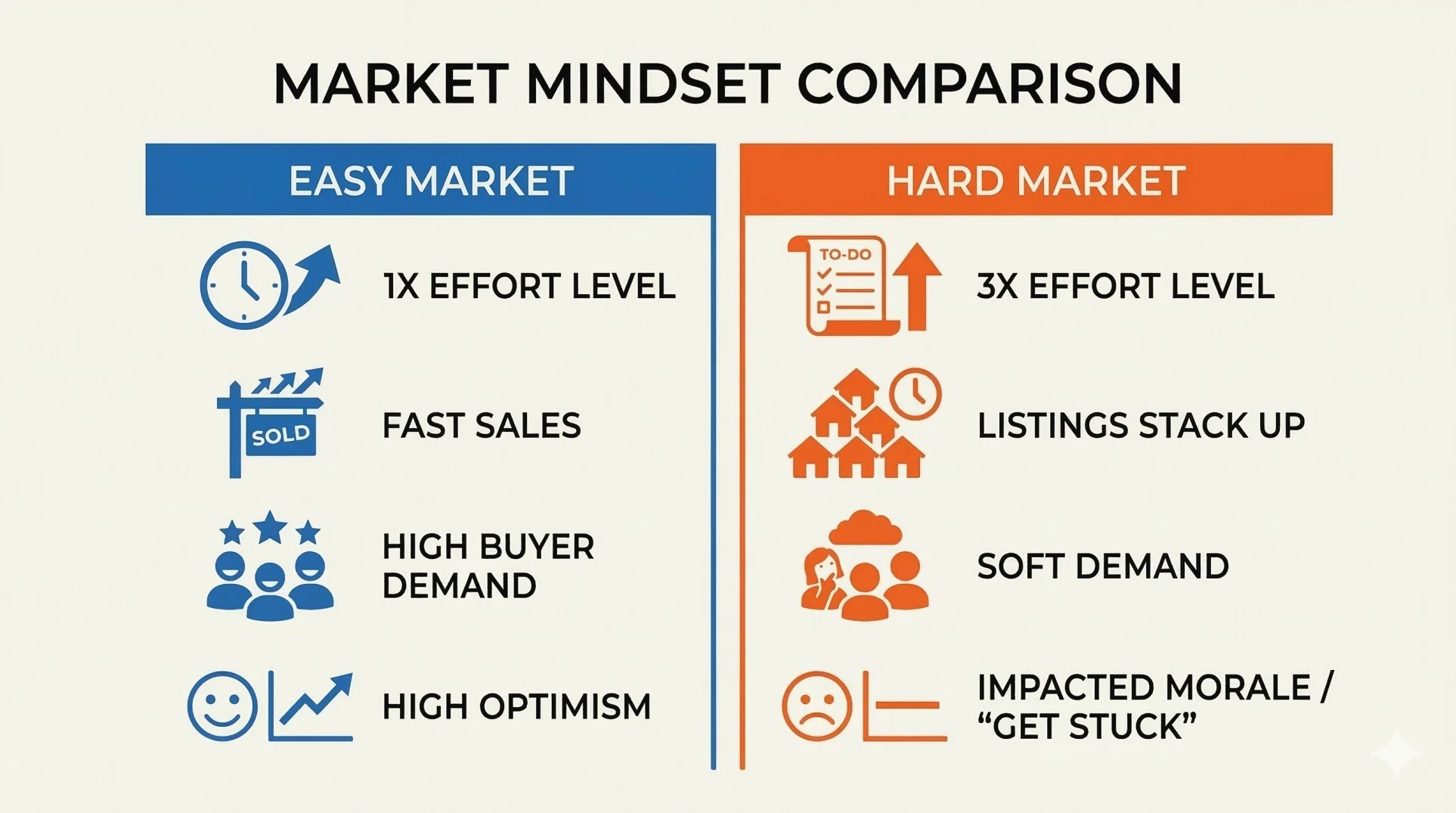
Rebecca operates in the Phoenix metro, which has been a competitive, sideways market for the last three years. Listings are stacking up, buyer demand has softened, and she acknowledges all of it. She just doesn't let it become her identity.
“It’s been a sideways market for the last three years. People are always saying, ‘Oh, there’s no buyers,’ because our listings are stacking up more. It’s definitely more work; we’re working maybe three times harder than we would in a real easy market. But I don’t get too hung up on all the noise. I just say, ‘There’s always a buyer, there’s always a seller.’ We’re going to find those people. I think the hard part is that agents are hearing so much constantly about how hard the market is that they buy into it. That impacts their morale and their desire, and then they get stuck. We don’t have to do that.”
That last line landed hard. "We don't have to do that." The market isn't choosing your attitude for you. Agents who internalize every negative headline are the ones who stop picking up the phone, stop prospecting, and eventually stop producing. Rebecca does none of that. She adjusts her effort to match the difficulty and keeps moving.
Systems Reduce Stress & Increase Production
Handling nearly 100 transactions a year without a large team behind you requires serious operational discipline. Rebecca told me her listing appointments follow a repeatable system with a folder, a resume, and a consistent presentation plan she adjusts for personality without rebuilding from scratch. The part that stuck with me most was her color-coded filing system.
“I have four file folders. Bright yellow is for every listing contract. Until that information is moved to a manila folder—which means they’ve moved to a listing—it stays in my listing drawer. Manila means they listed. For a buyer consult, I use a blue folder. When we find a home, that moves to a red folder. It’s so simple, but anytime I look at my file cabinet, I know exactly who’s a buyer and who’s listed by color. That’s a great ADD way of keeping things concise.”
It's low-tech, and that's the point. Real estate systems for agents don't need to cost $500 a month. They need to be simple enough that you'll actually use them. For agents with ADD (myself included), visual cues like this make a real difference in keeping your pipeline straight.
If you're looking for more ways top producers structure their operations, the ICONS of Real Estate Podcast Network features dozens of shows where agents share exactly how they run their businesses.
Building a Referral-Based Business (Without Cold Calling)
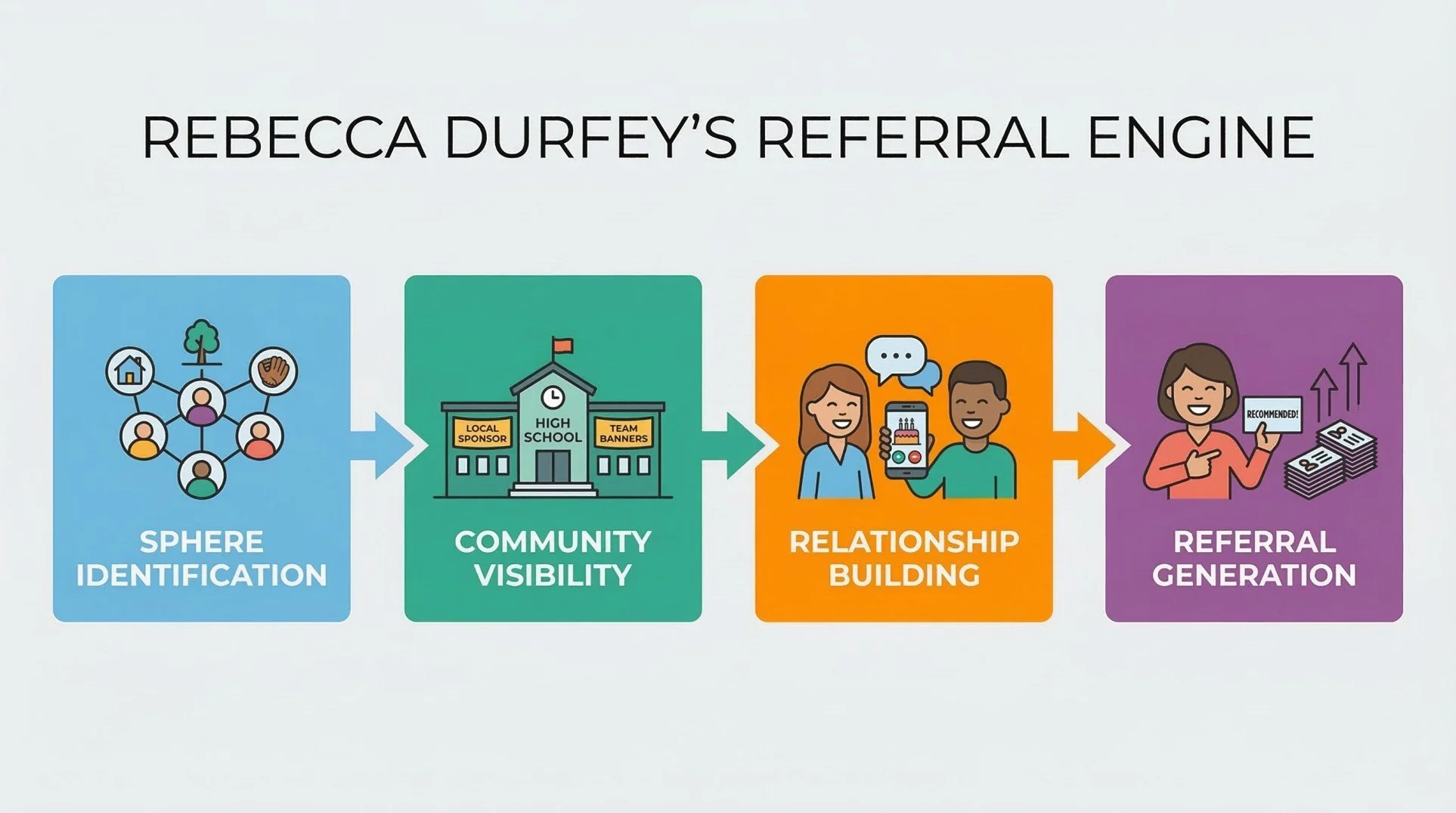
Rebecca Durfey, the Keller Williams Phoenix team leader, has built her entire career on referrals. She's never cold-called, never door-knocked. In a field where the median agent tenure sits well below a decade, that kind of longevity through organic growth alone is rare.
“I’ve never made a cold call or knocked on a door in my career, but I make sure I’m seeking out referrals and making people comfortable giving my name. I figured out my sphere. At that time, my boys were in Little League, so I was sponsoring teams and putting my name out there in my sphere. Now I have banners at high schools; I try to be very community-based. I treat my clients like friends, but business is business. I make sure I’m always available to talk about the market.”
Her approach breaks down into a handful of repeatable moves:
Identify your sphere early - Rebecca started with parents at Little League games.
Invest in community visibility - She sponsors high school teams and stays visible locally.
Treat clients like people, not transactions - Genuine relationships generate referrals naturally.
Stay top of mind - She makes birthday calls, sends personalized videos, and remains the go-to person for market questions.
She also works with relocation clients, sending video introductions, walking homes on FaceTime, and handling post-closing favors. That mentality is why people keep sending business her way. It’s the same reason we built VIP perks and local events into our own client experience—staying visible isn’t a campaign, it’s a lifestyle.
Always Be Available — Responsiveness Wins
This sounds almost too simple. Pick up your phone. Rebecca says she hears it ten times a year from new clients: you're the only agent who answered.
“People just do not realize that picking up your phone is key. I get phone calls 10 times a year where someone says, ‘You’re the only one that picked up.’ Just pick up your phone. It’s not that hard. And it’s okay to say, ‘I don’t know.’ For new agents: ‘I don’t know the answer, but I’m going to ask my broker and get back to you.’ People would rather hear that than a BS answer. If you get back to them, that is where trust starts to be built. If you’re scared and don’t call back, you fail. This is a job that requires confrontation.”
I tell agents the same thing: even if you're in a meeting, text back and say you'll call later. Then actually call. The agents who ghost leads because they're "too busy" are the ones wondering six months later why their pipeline dried up. Responsiveness costs nothing and builds trust faster than any marketing spend ever will.
Longevity in Real Estate — Why She Hasn't Burned Out
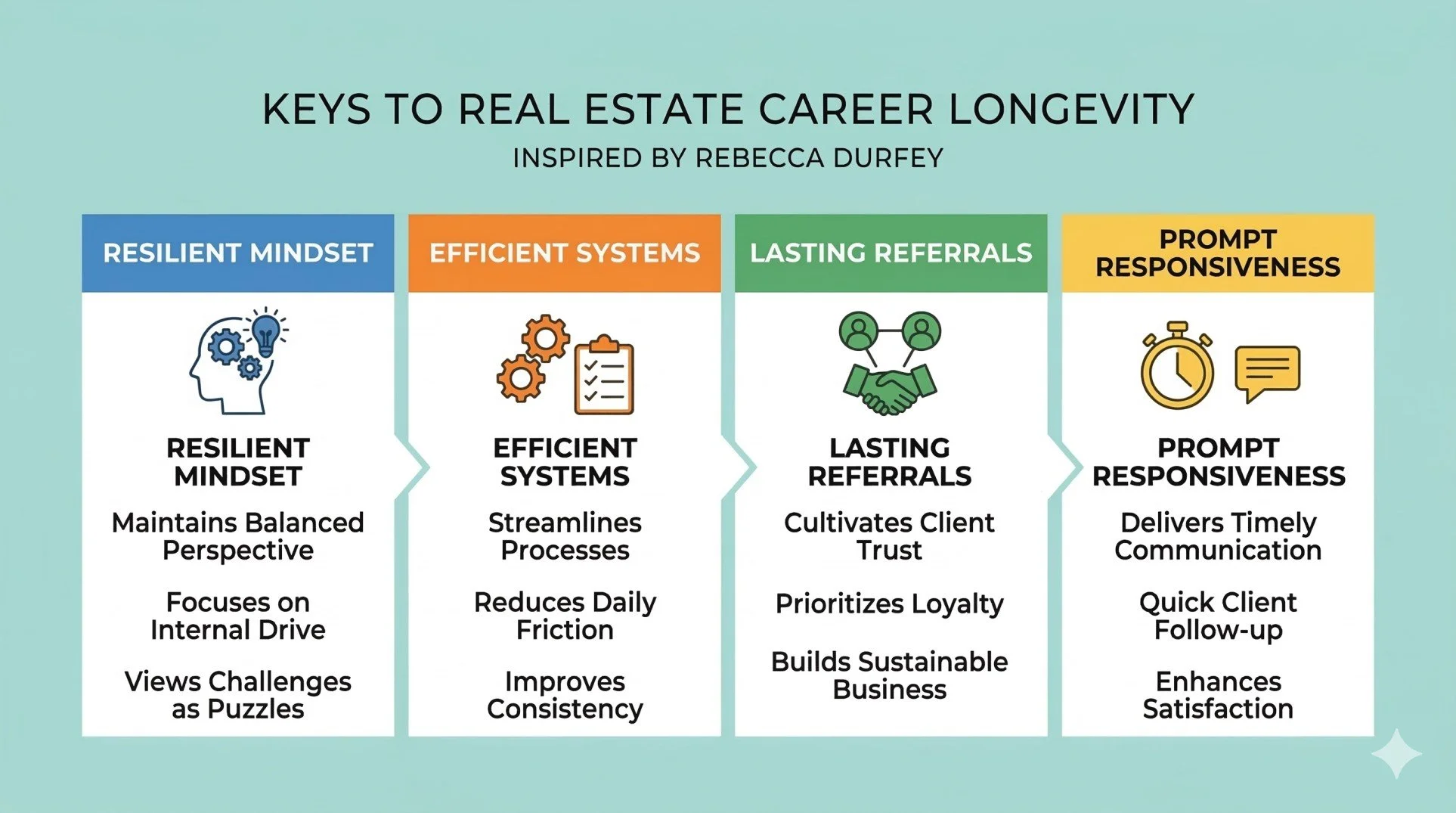
Twenty-three years in real estate is a long run by any measure, and Rebecca Durfey's Keller Williams Phoenix career stands as proof. She credits her longevity to perspective and an internal competitive streak that keeps the work interesting.
“In 2008, we were sitting across from people who had cancer and were losing their homes. You have a lump in your throat, but you’re the business person who helps them through it. That was a ‘sad’ market. This current market is just ‘hard’—it takes effort and patience, but it’s not sad. I also like the conquer; I like the puzzle. I’m competitive with myself—I don’t care what everyone else is doing, I just want to do better than I used to.”
She also talked about knowing when to step back. If you want to know how to avoid burnout in real estate, Rebecca's answer is deceptively simple: she calls it "stepping off the world for a minute," which sometimes means watching Dateline and eating chicken noodle soup before jumping back in. The agents who burn out are the ones who never give themselves permission to pause.
Focus on One Weakness at a Time
Rebecca's closing advice was the most actionable thing she said all episode. Agents who try to fix everything simultaneously fix nothing. Her approach: pick the one thing that's hurting you the most, master it, then move to the next.
“I would say if you can figure out your weakness—whether it’s data, negotiating, or just picking up the phone—work on that one thing first. Don’t look at five things at once. Focus on one thing, get good at it, then move to the next. I don’t think anybody ‘sucks’ at this if they care about people and know how to put a deal together. You just have to put in the time and the effort.”
I asked Rebecca if there's a common thread among the agents she's seen struggle, and her answer kept circling back to one behavior: they stop. They stop calling, stop learning, stop showing up. The agents who succeed are the ones who treat every gap in their game as something fixable and then put in the reps.
If you're looking for more tactical advice from agents in the field, our blog covers everything from working with investor clients to building sustainable careers.
What Rebecca Durfey has built over 23 years in the Phoenix market proves the formula is straightforward: simple systems, repeatable habits, and genuine care for people. The only real differentiator is doing the work, every single day.
Frequently Asked Questions
Who is Rebecca Durfey?
She is a Realtor and team leader with Keller Williams Realty Professional Partners in the Greater Phoenix Metro area, ranking in the top 1% of agents in Arizona and the top 1.5% nationally.
How did she become a top 1% Realtor?
Through referral-based growth, consistent systems, deep market knowledge, and a service-first mindset. She closes approximately 97 to 100 transactions per year as a solo producing agent.
How can Realtors build a referral-based business without cold calling?
She recommends identifying your sphere, investing in community visibility through sponsorships, treating clients as long-term relationships, and staying top of mind with regular communication.
What systems help real estate agents stay organized?
She uses a color-coded filing system with four folder colors: bright yellow for listing contracts, manila for active listings, blue for buyer consultations, and red for buyers under contract. She also follows a repeatable listing appointment process.
Why is responsiveness critical in real estate?
She regularly hears from new clients that she was the only agent who picked up the phone. Answering calls and following up builds trust faster than any other strategy.
How do you survive a tough housing market as an agent?
She advises against buying into negative market narratives. The current market requires working three times harder, but there's always a buyer and always a seller if you stay focused.
What is the key to long-term success in real estate?
A genuine desire to serve people, paired with strong operational systems and continuous skill development.
How do top Realtors avoid burnout?
She takes intentional breaks when needed, maintains perspective by comparing current challenges to genuinely difficult markets like 2008, and stays competitive with herself.
What is the best way for new agents to improve quickly?
Focus on one weakness at a time. Master that skill before trying to fix everything else simultaneously.
Does passion alone make you successful in real estate?
No. Rebecca is clear that passion without skill won't sustain a career. Competence in negotiation, market data, and client communication is what turns a single transaction into a lasting business.
This podcast is produced by the Icons of Real Estate - #1 Real Estate Podcast Network
Apply to Be a Guest on the Why Do I Suck as a Real Estate Agent Podcast
Stories like Rebecca Durfey's Keller Williams Phoenix career prove that systems, service, and referrals still win. If you're actively working in real estate and have insights worth sharing, whether in brokerage, investing, team building, or client service, we want to hear from you.
