
Chris Charles of Town n' Country Title: Lessons on Why Agents Succeed or Struggle
What separates a real estate agent who lasts twenty years from one who quits after two? I took that question to ChrisCharles of Town n' Country Title, who sees hundreds of agents every year from the other side of the closing table. He has been my mentor for nearly a decade.
In this episode of the Why Do I Suck As a Real Estate Agent podcast, he gave me a masterclass on communication, real estate wire fraud prevention, and the quiet habits that build real careers.
Tune in to the full conversation:
Why I Had This Conversation
I have interviewed a lot of agents and brokers on this show. But I had never sat down with anyone from the title company role in real estate transactions side. That felt like a massive blind spot.
Chris Charles of Town n' Country Title has been one of my mentors for the last seven or eight years. He is the guy who hands me the check on closing day. He is also the guy I call when I hit something I do not understand in a file.
More importantly, he sees hundreds of agents every year. That means he has a view of our industry that most of us never get. He watches us work from the outside and quietly ranks who is dialed in and who is not. Bringing his perspective to this audience was too valuable to skip.
The most common reason agents lose clients is a lack of communication. At the core of real estate is a constant duty to communicate clearly, act with integrity, and put clients first. When these principles slip—even unintentionally—the results can be costly. Chris sees this play out in real time from the title chair.
The Only Three Traits That Separate Great Agents From Struggling Ones — Communication, Communication, and Communication
When I asked Chris Charles of Town n' Country Title what the best agents he works with have in common, he did not give me three different answers. He gave me the same answer three times.
He told me about a now-retired agent named Nancy Van Stradden. Her business card still sits on his bulletin board. Not because of her volume, but because of how she ran her files.
"The three traits were communication, communication, and communication. When she would place that order, it sounds goofy, but that subject line would have an address in the subject line, not DocuSign some mumbo-jumbo. And then in that email, she did more than just attach that offer to purchase — she would also say, 'Chris, here's all the contact information for my seller, here's the contact information for the buyer, here's the contact information for the lender.'"
The takeaway for me was how unglamorous the winning behaviors actually are. It is not a flashy CRM or a lead-gen funnel. It is putting the property address in the email subject line so your title rep does not have to dig. It is sending all the contact info on day one so every party knows who to call.
And it is replying to emails even when you do not have the answer yet. Just acknowledging you got it. That last one is what most newer agents skip. It quietly destroys trust over a 30 to 60-day transaction.

The habits of successful real estate agents start with small, consistent actions. A referral-based real estate business depends on the same communication skills Nancy used. For realtors looking to improve their transaction processes, Chris's team offers resources that reward organized agents.
Why "Commission Breath" Is the Fastest Way to Kill Your Reputation
We hit a topic I have been thinking about for a while: commission breath real estate agents. Why real estate agents fail often comes down to prioritizing the check over the client. Chris Charles of Town n' Country Title told me about an agent who, after six or seven emails into a transaction, starts peppering him with messages that essentially translate to "you do have my address, right?" The address to mail her commission check.
The sub-message underneath that is unmistakable. You are thinking about your paycheck before you are thinking about your client.
"I think, again, real estate agents are in a tough spot because you do all that work for, if it's weeks or months, and then all of a sudden that closing day comes… But I think the good agents are, 'Would I be able to get a review, get some feedback? How was the experience?' So if you're thinking about that client more so than that commission check — the check's coming, you know, in the trust account — that check's going to clear. But that customer, you have an opportunity to try to make sure there is no buyer's remorse."
The lesson I took from this is simple. Your check is guaranteed the moment you get to the closing table. What is not guaranteed is the review, the referral, and the repeat business. Agents with commission breath optimize for the one thing that is already locked in and ignore the thing that actually builds their next five years of income.
According to the National Association of Realtors, 77% of sellers find their agent through a referral or repeat business. For buyers, that number is 67%. Even more telling, 87% of sellers say they are likely to refer their agent after the transaction closes. Yet many agents never see those referrals because they stop thinking about the client the moment they get paid. Chris has watched this pattern repeat for over two decades from the title chair.
The Costly Mistakes Agents Make When They Fight the Wrong Battles
One of the patterns Chris Charles of Town n' Country Title sees over and over is agents losing deals by digging in over small dollar amounts. He told me a story about his own in-laws selling a house. They ended up in a full-blown standoff over a washer and dryer that would have cost roughly $500 to replace. The seller dug in. The buyer dug in. Neither agent created a win-win. The whole transaction turned into a nightmare over what a trip to Home Depot would have fixed.
I have been on the other side of that math. Last year, I listed a lake property an hour away, rushed the details, and wrote a dishwasher into the listing that was not actually there. When the buyer wrote it into their offer, I did not go back to my seller and reopen the negotiation. I took the dishwasher out of my own commission. That is the cost of my mistake, not my client's problem.
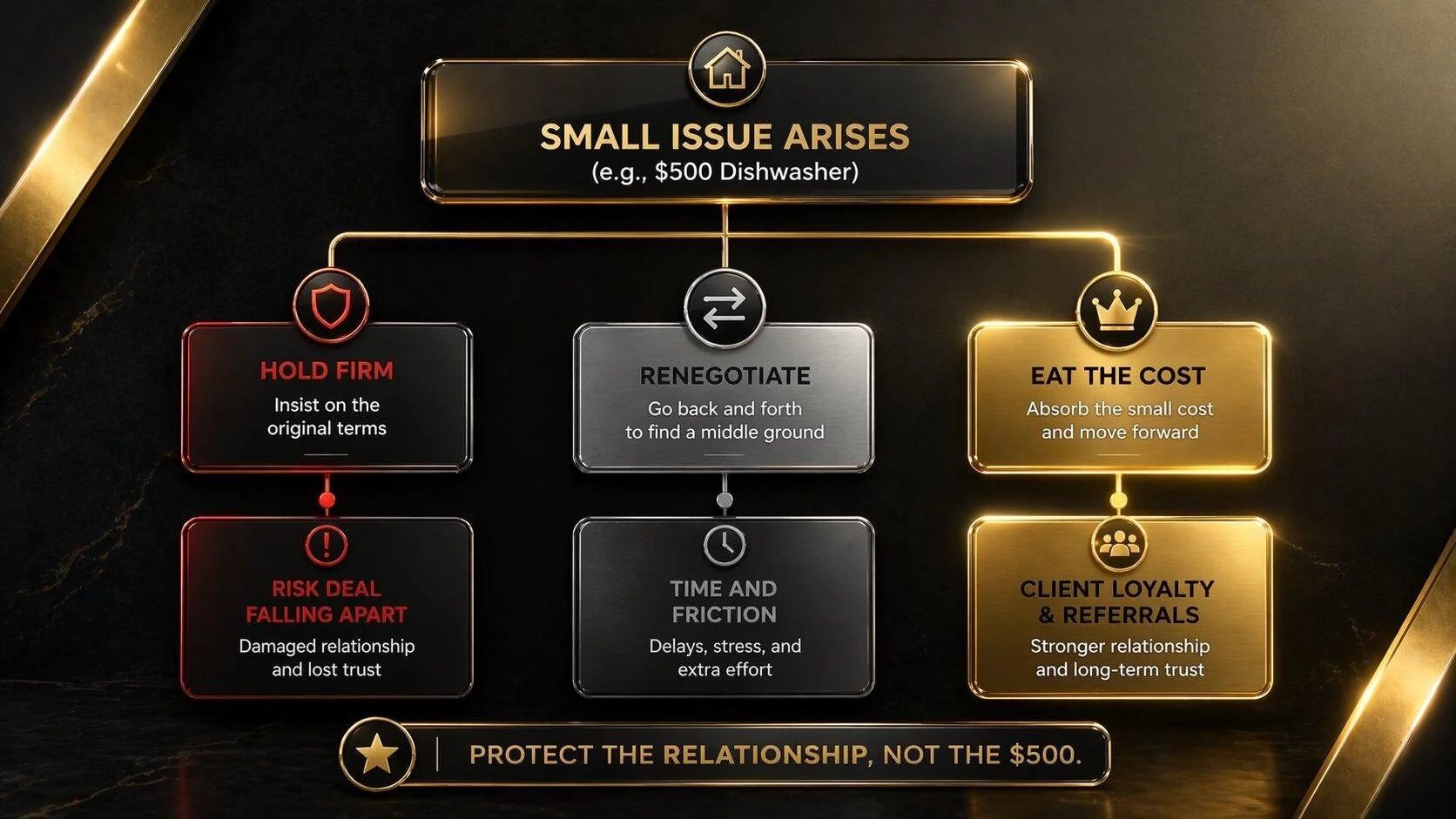
The real lesson is harder than most new agents want to hear. You are going to make mistakes. You are going to miss something in a listing. You are going to have clients who want to fight over small stuff.
The agents who build long careers take accountability, find a compromise, and protect the relationship. The ones who want to win every argument tend to close fewer deals and get fewer reviews. A long-term real estate career requires eating your mistakes and protecting the relationship.
Wire Fraud Isn't an "If" — It's a "When"
This was the section of the conversation I wish every newer agent would listen to on loop. I got spoofed a few months ago on a transaction. A fraudster cloned my email address with a tiny character change and sent altered wire instructions to the buyer's lender. Thankfully, the lender caught it because the writing did not sound like me. But we came close to losing an $850,000 wire.
"The thought process would be it isn't if you're going to be somehow involved in some kind of email spoof, wire fraud — it's just when. So putting policies and procedures in place: if your broker-owner or somebody that's mentoring you tells you something, please, please, please listen — because you do not want to be involved in a transaction where a buyer walked into their credit union, they were given bad wire instructions, and by the time they went into their bank and sent that money out, it's too late."
Chris's practical advice was blunt. Get off the free email accounts. Turn on two-factor authentication on everything. Build a verification habit with your clients before closing week, not during.
For every cash deal I handle now, Chris sends the wire instructions. Then, I have the buyer call the title company directly. They use a number they already have on file to verbally confirm the instructions before any money is transferred. It takes five minutes, and it is the cheapest insurance policy in the business. Chris's team even includes a wire fraud warning on their order title page, which every agent should review with their clients.
The Federal Trade Commission provides detailed resources on wire fraud and how to report it. Every agent should review them.

Why Not Showing Up to Closing Is Costing You Referrals You'll Never See
This one genuinely surprised me. Chris told me that fifteen or twenty years ago, every agent on every file showed up at closing. Now, he says, it is routine for agents to skip. I have closed well over a hundred deals in my career, and I still show up to every single one I can.
The closing table is the last emotional moment of a long relationship. It is the moment the client actually feels the finish line. And if you are not there for it, you are telling them, whether you mean to or not, that you were in it for the paycheck.
"If there's a conflict where you can't make it, if there's somebody else from your office that might be able to go just to reinforce that relationship. Because you can't guarantee who else is going to be there. You know your client's going to be there. If you're a new real estate agent, if the lender shows up, well, now you have an opportunity to meet that lender face-to-face and build that network, that relationship."
The tactical piece that newer agents miss is that closing is also a free networking event. Lenders, attorneys, title reps, and cooperating agents are all in the room. They all take notes on who showed up and who did not. Building relationships with lenders at the closing table can lead to more referrals down the road.
What Changed for Me After This Conversation
Talking with Chris reminded me that the agents I trust most in this business share one quality. It is not volume. It is a willingness to teach.
"Find people who have the heart of a teacher. There's a lot to learn… If I'm working with somebody who maybe doesn't have that mindset, I normally don't work with that person much longer for different reasons. It's not fun. Because I love what I get to do, and I really love the people I get to do it with. So if real estate is for you, you can have, I hope, that same experience that I have."
My takeaway as a host is simple. The people who last in this industry are not the ones who know the most on day one. They are the ones who stay curious on day 10,000. After this conversation, I am being more intentional about who I spend time with professionally. I want mentors who teach, not ones who make me feel stupid for asking.
Real estate coaching for agents is valuable, but finding people with a heart of a teacher is what Chris taught me. And I am going to keep showing up at every closing I can, keep verifying every wire, and keep running my files with the kind of communication Nancy Van Stradden left on Chris's bulletin board. For both homeowners and prospective buyers, having an agent who understands the closing process from the title side makes all the difference.
Hear the entire conversation with Chris Charles on communication, commission breath, and closing table habits. Listen to the podcast episode.
FAQ Section
What does a title company actually do in a real estate transaction?
Title companies in real estate transactions ensure clear ownership, settle liens, and manage the closing process by preparing documents and guiding parties involved. They may also address post-closing issues like unpaid bills or legal discrepancies. Title insurance Wisconsin also plays a crucial role in safeguarding against potential title defects.
How do I protect my clients from real estate wire fraud prevention?
Treat wire fraud as a certainty. Avoid free email services for client work and enable two-factor authentication. Establish a verification habit where clients confirm wire instructions directly with the title company using known contact numbers. Inform clients early that wire instructions won’t change at the last minute via email, and any urgency to wire funds is a red flag.
Should I attend every closing I'm a part of as a real estate agent?
Yes, whenever it is physically possible. The closing is the last emotional moment in the transaction and the one your client will remember most. It is where reviews, referrals, and repeat business are either earned or lost. If you truly cannot make it, send a colleague from your office in your place. Skipping closings is one of the quietest ways newer agents signal to clients that they were in it for the commission.
Apply as a Guest on the Why Do I Suck As a Real Estate Agent Podcast
Real estate is a craft. The agents who last in it are not the loudest. They are the most honest about what they got wrong and what they finally learned. If you are working in real estate, title, lending, or any adjacent corner of this industry and you are solving real problems for real clients, I want to hear from you.
